Table of Contents
- The Ultimate Eames Lounge Chair & Ottoman Guide
- ‘Take your pleasure seriously.’
- Authenticity
- The Base:
- Chairs bases in the "Style of Eames"
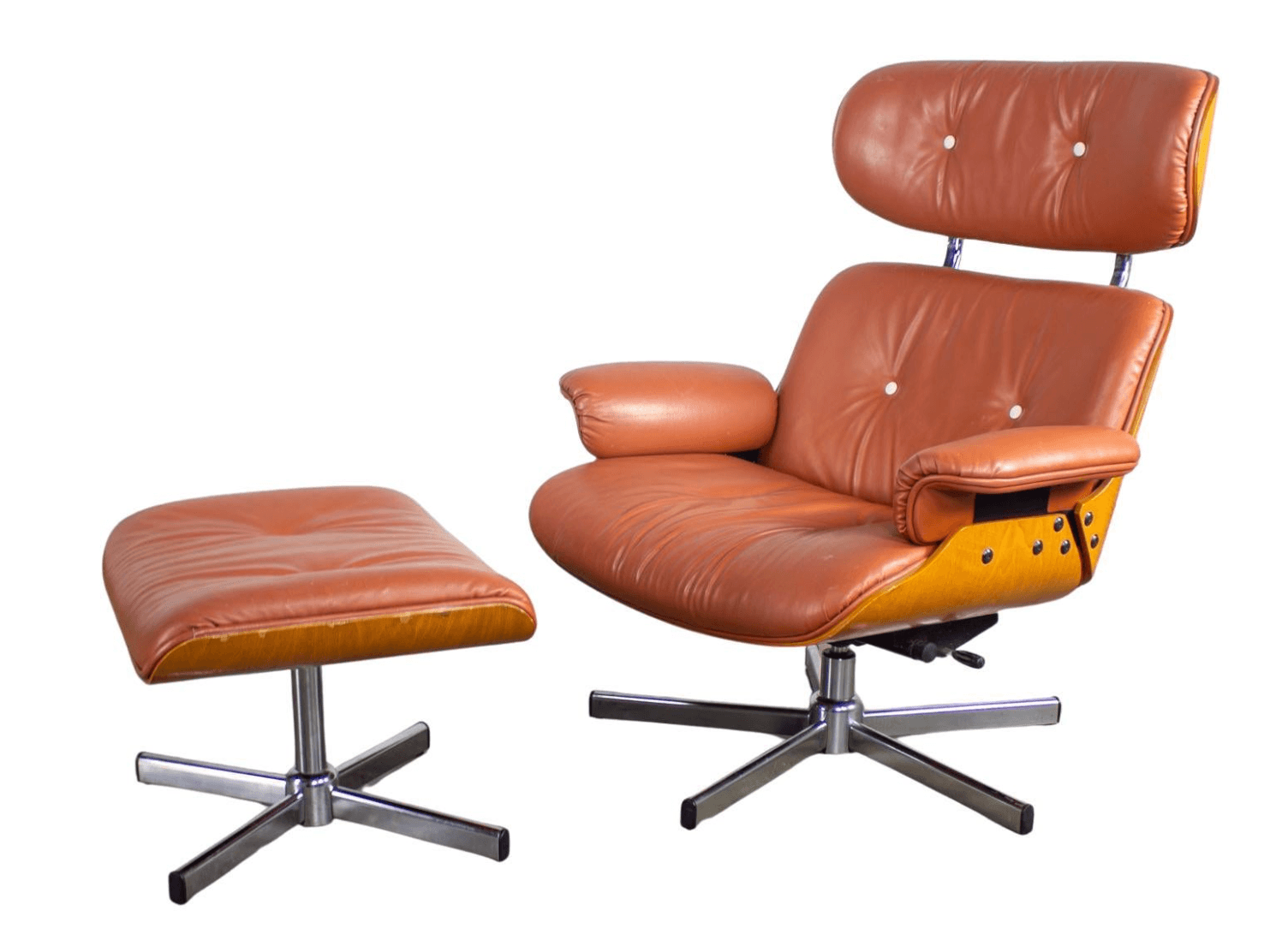
- Vintage Chair in the Style of Eames. Not an Authentic chair. Notice the ottoman has five legs as does the chair. The Base lacks the proper black enamel paint and polished aluminum blade tops. These bases have squared off ends, while they should be rounded. Domes of Silence are absent. Another Chair in the Style of Eames, not an authentic chair . Most likely a Plycraft or Selig chair.THE SHELLS
- THE WOOD
- THE CUSHIONS
- THE LABEL
- CHANGES OVER THE YEARS
- 1st Generation 1956-57
- Comparison of two Eames Lounge Chair Backrests. You can see the shape of the "wings" have changed overtime.1st Generation Ottoman without its boot glides on. Base shows "no holes" indicating it never had domes of silence installed. 1st Generation Eames Lounge Chair with boot glide ottoman
- 2nd Generation Eames Lounge Chair 1960 - 1969
- SIGNS OF A FAKE
- Quick Picture Guide to Spotting Fakes
- FAQs
The Ultimate Eames Lounge Chair & Ottoman Guide
Charles and Ray Eames believed design could make the world a better place — that furniture could bring genuine pleasure and functionality to everyday life. Much of their career was devoted to mastering the art of bending plywood and fiberglass. During World War II, Charles designed molded bentwood leg splints for the military. After the war, he turned his attention to creating modern, versatile furniture from wood, metal, and fiberglass — pieces equally at home in a university lecture hall or a formal dining room, with nothing more than a change of base.
In 1950, the power couple set their sights on the luxury market. Their goal: to reimagine the classic English club chair for a changing America. and thus, the Eames Lounge Chair was born.
‘Take your pleasure seriously.’
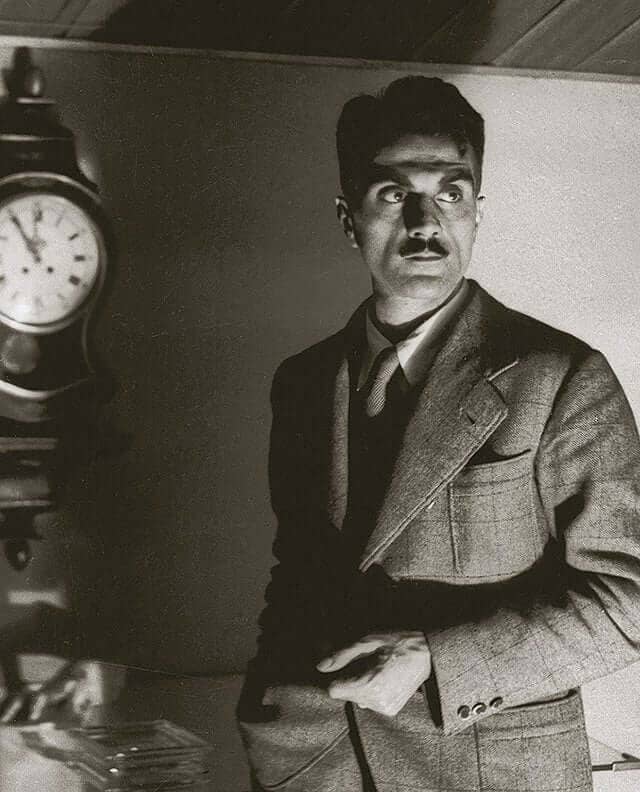
Charles & Ray Eames
The Eames Lounge Chair (1956) was their first foray into the world of high-end luxury goods. They envisioned the chair as a refuge from the strains of modern living — the culmination of a decade spent forming wood into new shapes. It was a decisive departure from their earlier work: no expense was spared. Nearly six years in development and through 13 arm redesigns, the Eames Lounge Chair made its national debut in 1956 when Arlene Francis introduced it to a prime-time television audience.
Charles Eames described wanting the chair to emit "the warm receptive look of a well-used first baseman's mitt." Pairing soft, inviting leather with the sleek form of molded rosewood, the chair was entirely hand-assembled from the highest-quality materials and built to last a lifetime. Shortly after its debut, it entered the permanent collection of the Museum of Modern Art. In continuous production ever since, it is widely considered one of the most significant designs of the 20th century.
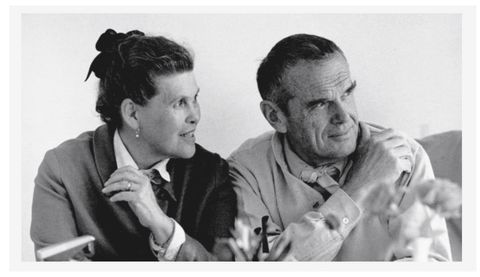
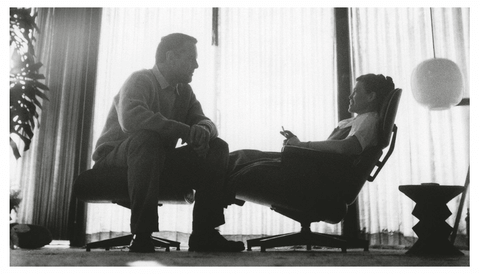
In 1961, Playboy sang the chair’s praises by saying the Eames Lounge Chair and ottoman “sank the sitter into a voluptuous luxury that few mortals since Nero have known”. In continuous production since its introduction in 1956, the Eames Lounge chair is widely considered one of the most significant designs of the 20th century.
Authenticity
The best way to know whether a lounge chair is genuine is to study the real thing. Like distinguishing authentic currency, you look at the real article long enough and you will sense when something is off. At Hobbs Modern, we have worked on countless authentic Eames Lounge Chairs and studied every detail of the design. As Eames himself put it: "The details make the design." When it comes to authentication, it truly is all in the details.
Click to see Hobbs Modern's Collection of Vintage Eames Chairs
The Base: 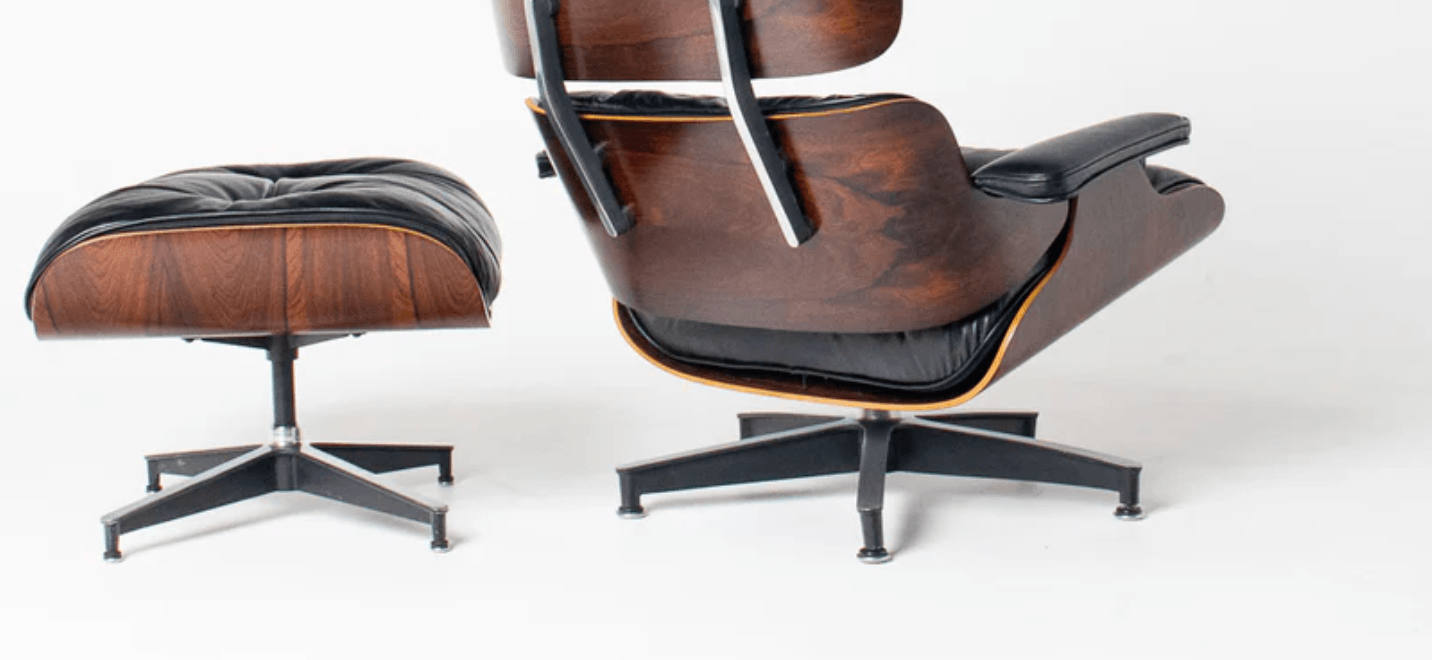
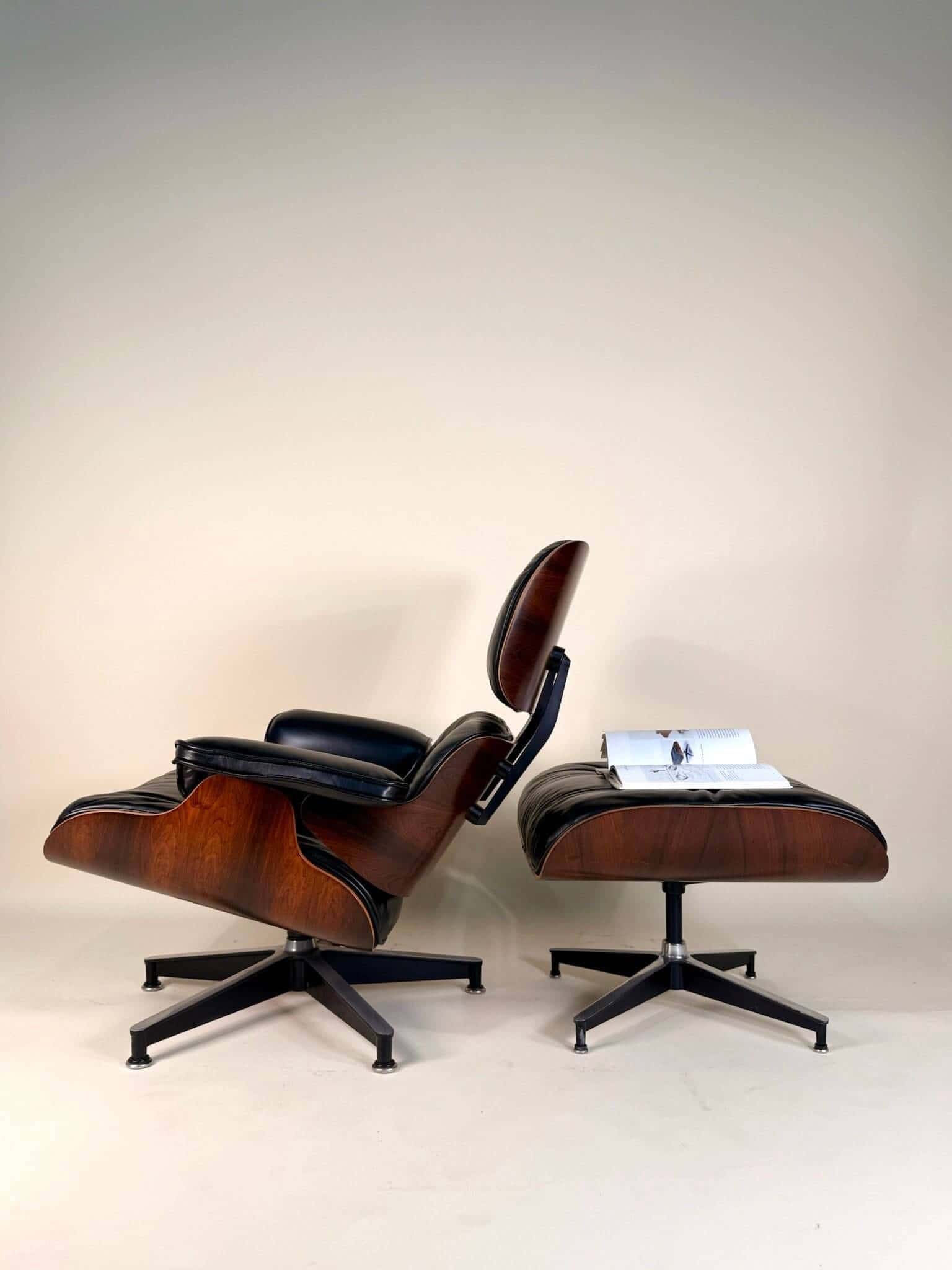
5 Legs on the Chair, 4 Legs on the Ottoman An authentic Eames Lounge Chair has a 5-leg base; the ottoman has 4 legs. The iconic 5-blade base was adapted directly from an Eames dining table base introduced a year earlier in 1955. When the lounge chair (Model 670) debuted in 1956, the Eames repurposed that table base for the chair. Because table bases don't bear the shifting weight of a human body, the earliest chair bases had issues with their threaded feet — a problem corrected on subsequent production runs.
Finish: The bases have a black enamel finish on the underside, with polished aluminum tops that are left exposed. The aluminum is not lacquered from the factory; it is designed to patina naturally over time.
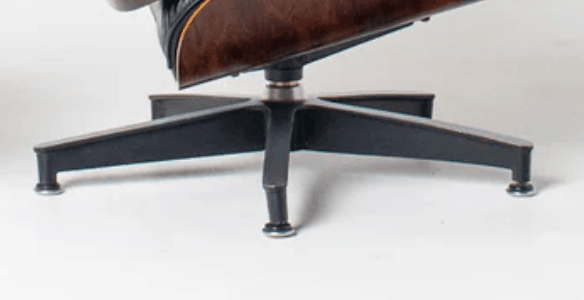 Authentic Eames Lounge Chair BaseSlight Angle: The legs have a subtle, graceful angle — not flat, and not the steep rake seen on many copies, which gives knock-offs the appearance of standing on tiptoe.
 Full 360° Swivel: The chair swivels a full 360°. The ottoman does not swivel. Authentic chairs have a substantial, well-weighted feel and spin with ease.
Exception: The very first 100 or so Eames chairs built had a swiveling ottoman. According to legend Charles and Ray Eames worried a spinning ottoman may be dangerous for children so it was quickly discontinued. A spinning ottoman with boot glides is the stuff of Eames Lounge chair legends. If you have or find a chair like this, cherish it, it's the rarest of all Eames lounge chairs, the ultimate collectors item.
Solid Aluminum Legs: Each leg is cast from a solid piece of aluminum, with a rounded end — never square. The chair and ottoman legs have a heavy, substantial feel, particularly on 1st and 2nd generation examples. Early chair bases were sand-cast, making them heavier and slightly more raw in form. From the 1970s onward, die-cast aluminum became standard, producing a more refined look and meaningfully lighter weight.
Finish: The legs are polished aluminum, which patina over time and can develop a pleasingly matte quality. The underside of each base has a matte black lacquer or enamel finish.
Adjustable Glides: The feet are a combination of rubber and metal. On chairs made from 1956 to 1970, each foot is marked "Domes of Silence." Current production chairs retain adjustable glides but no longer carry this marking.
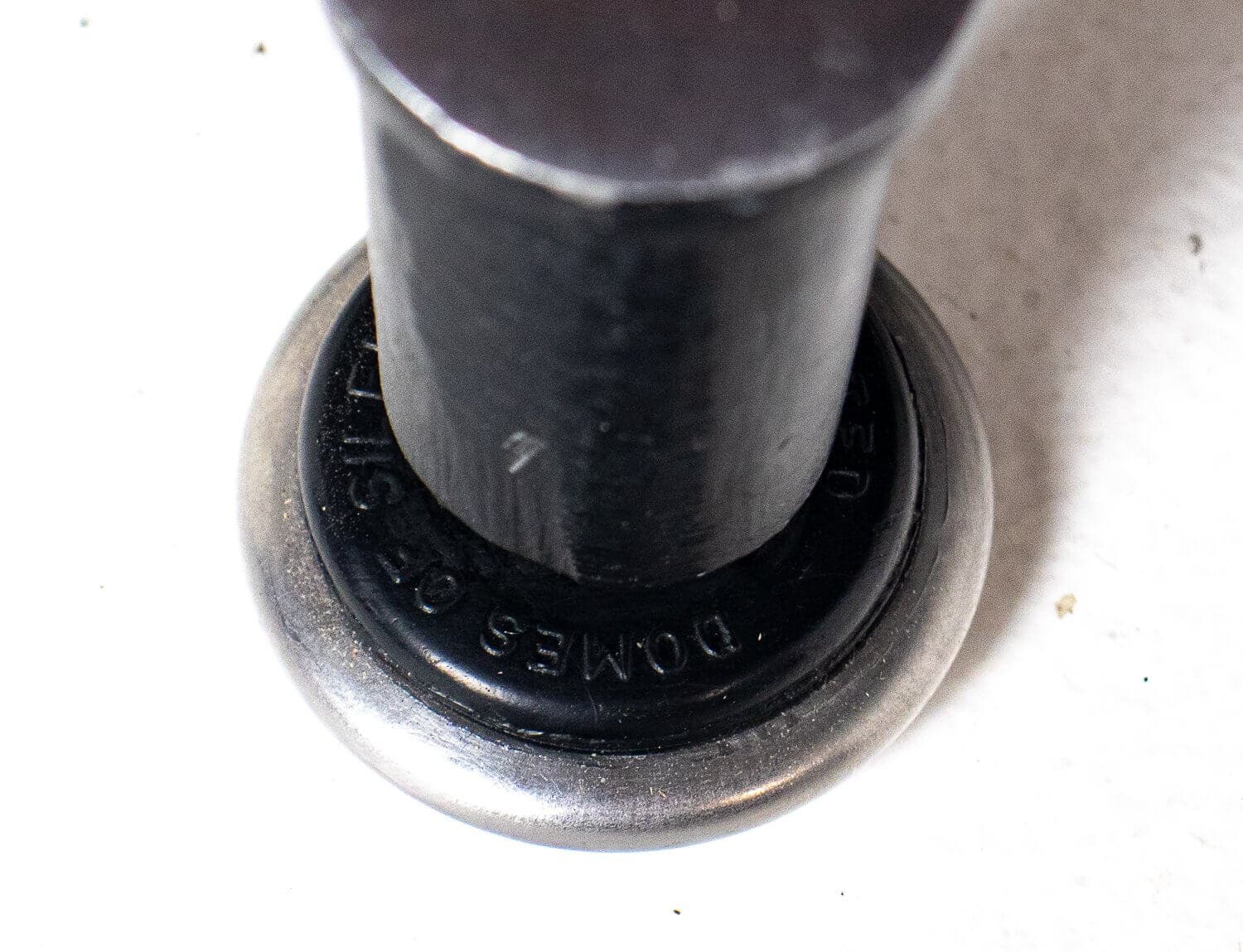 Authentic Feet of an Vintage Eames Lounge Chair are marked "Domes of Silence". Retractable Feet allow the chair to be leveled on an uneven floor.
 15° Angle - the chair is set at a permanent 15° angle.
15° Angle - the chair is set at a permanent 15° angleChairs bases in the "Style of Eames"
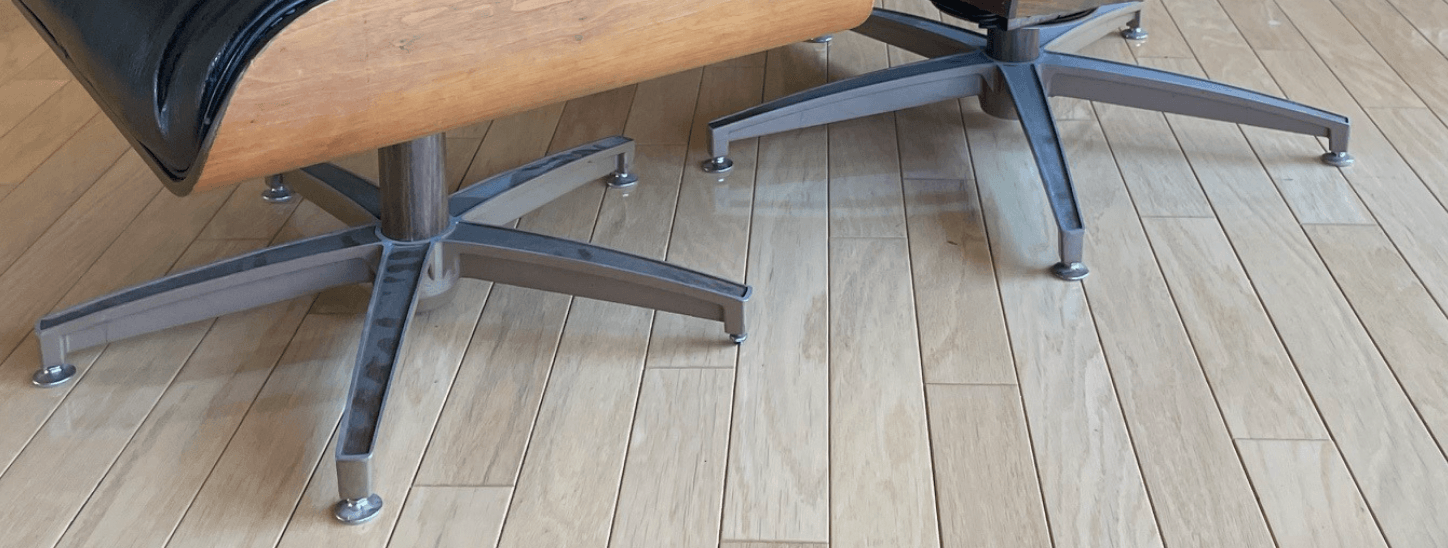 Vintage Chair in the Style of Eames. Not an Authentic chair. Notice the ottoman has five legs as does the chair. The Base lacks the proper black enamel paint and polished aluminum blade tops. These bases have squared off ends, while they should be rounded. Domes of Silence are absent.
Vintage Chair in the Style of Eames. Not an Authentic chair. Notice the ottoman has five legs as does the chair. The Base lacks the proper black enamel paint and polished aluminum blade tops. These bases have squared off ends, while they should be rounded. Domes of Silence are absent. 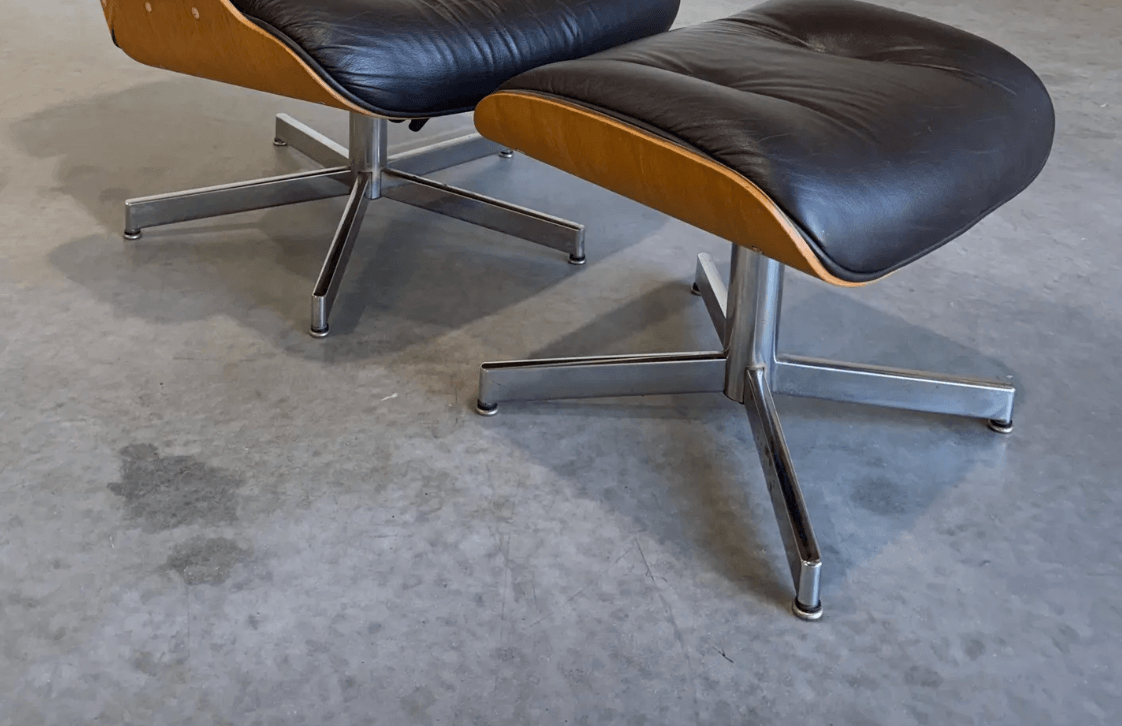 Another Chair in the Style of Eames, not an authentic chair . Most likely a Plycraft or Selig chair.
THE SHELLS
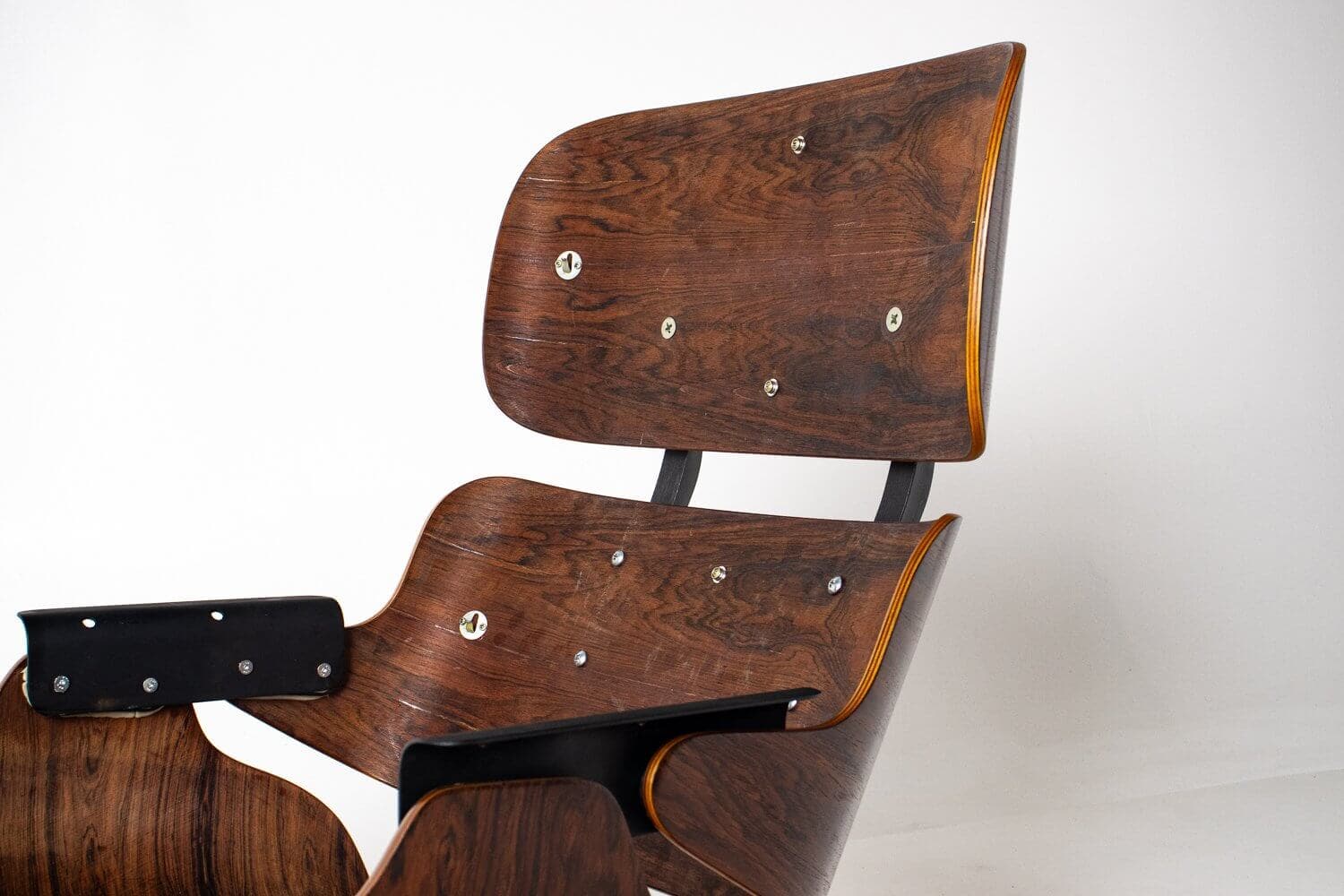
No Exposed Screws: All screws on an authentic Eames Lounge Chair are hidden on the interior of the shells — with one deliberate exception at the armrests. Any screw visible on the exterior of the wood shells is a clear sign the chair is not authentic. Or it has been badly repaired.
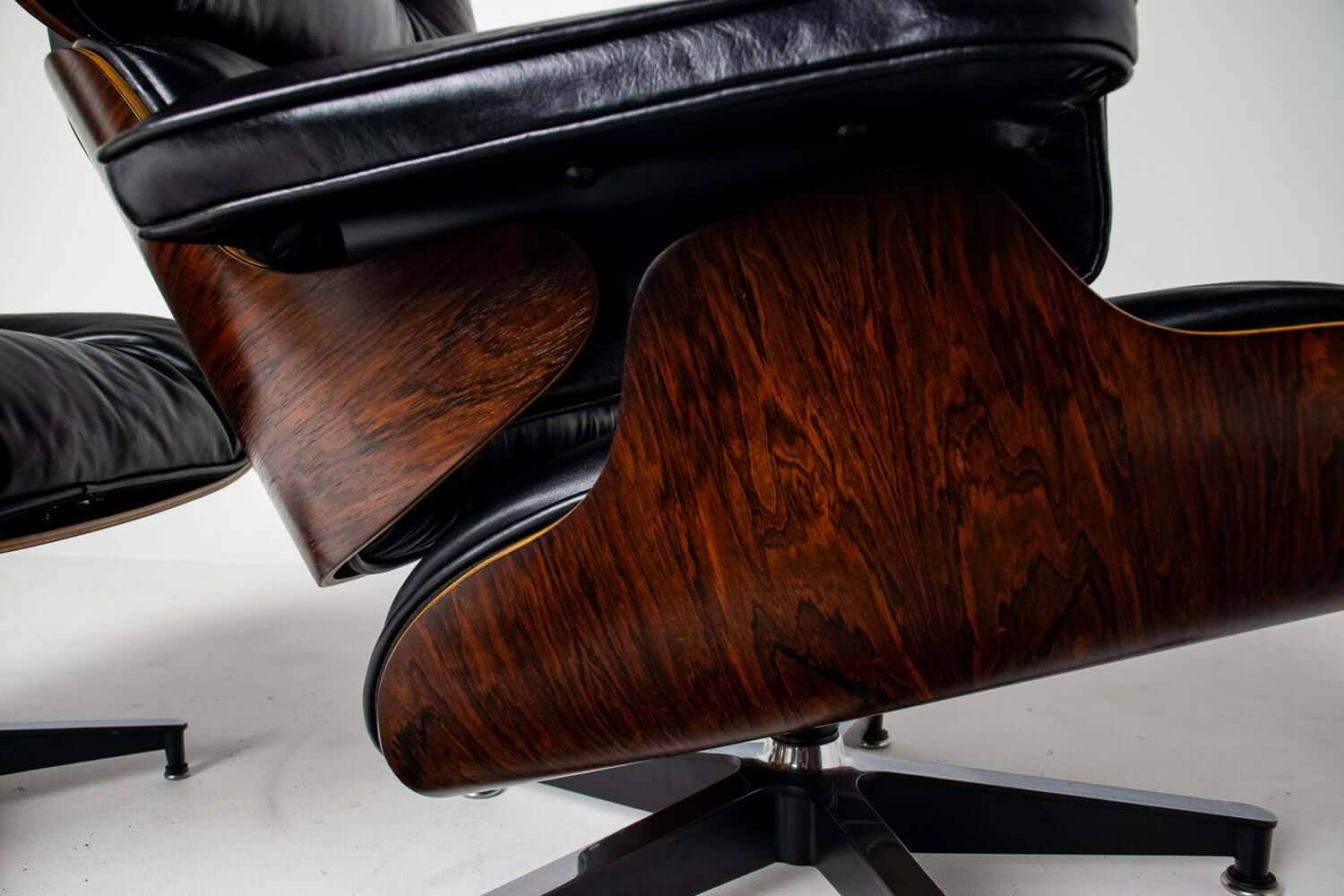 Authentic Eames Lounge Chair without any exposed screws under the arms
 Exposed screw on the outside of the wood shells are a sure sign the chair is not authentic.
 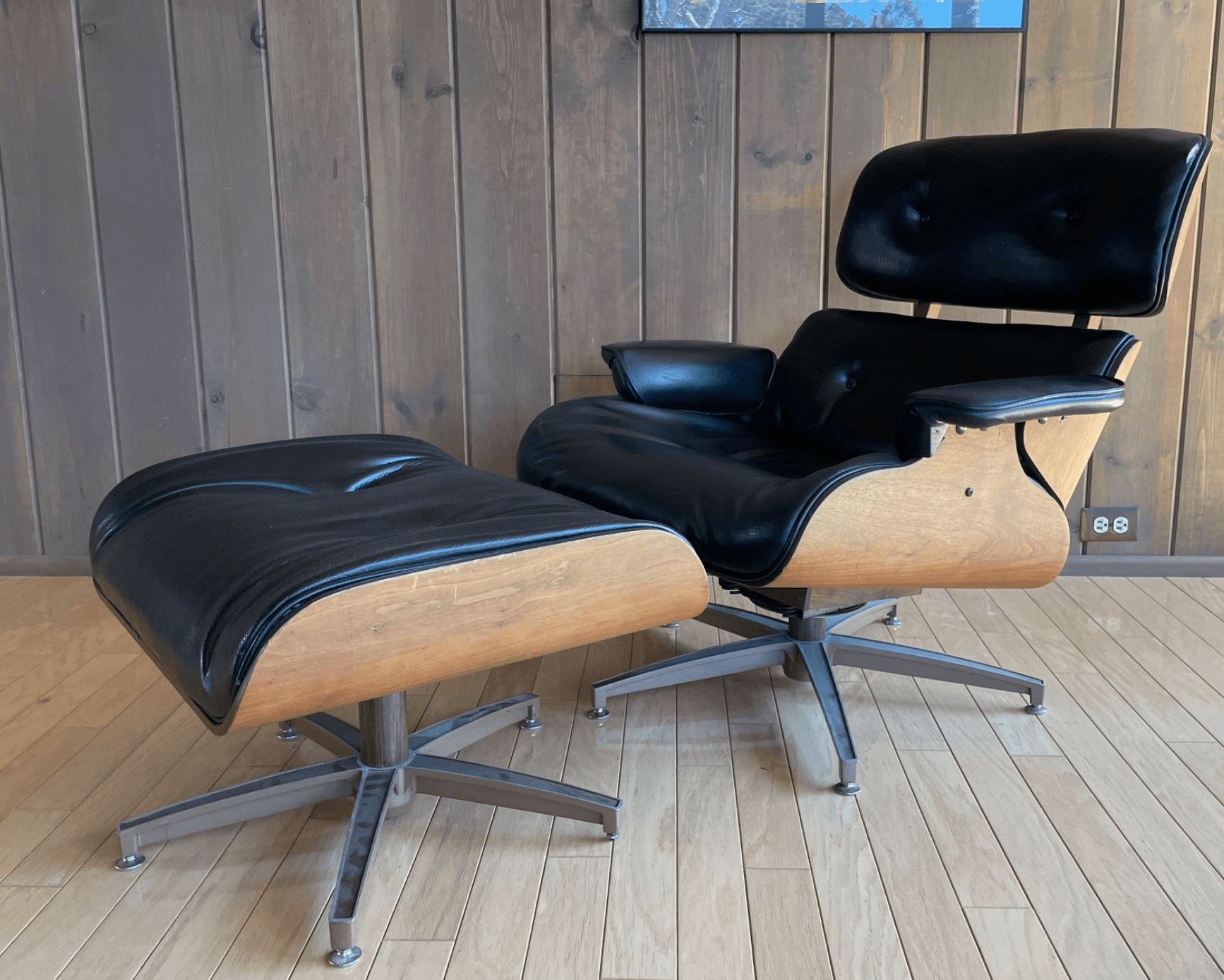 Another Vintage copy of an Eames Lounge Chair
3 Shells- the Eames Lounge Chair is made up of three plywood shells, the seat (bottom), the back (middle) and the headrest (top). They should look like they are all floating. On Vintage Eames lounge chairs every shell should have rosewood veneer on the inside as well as the outside.
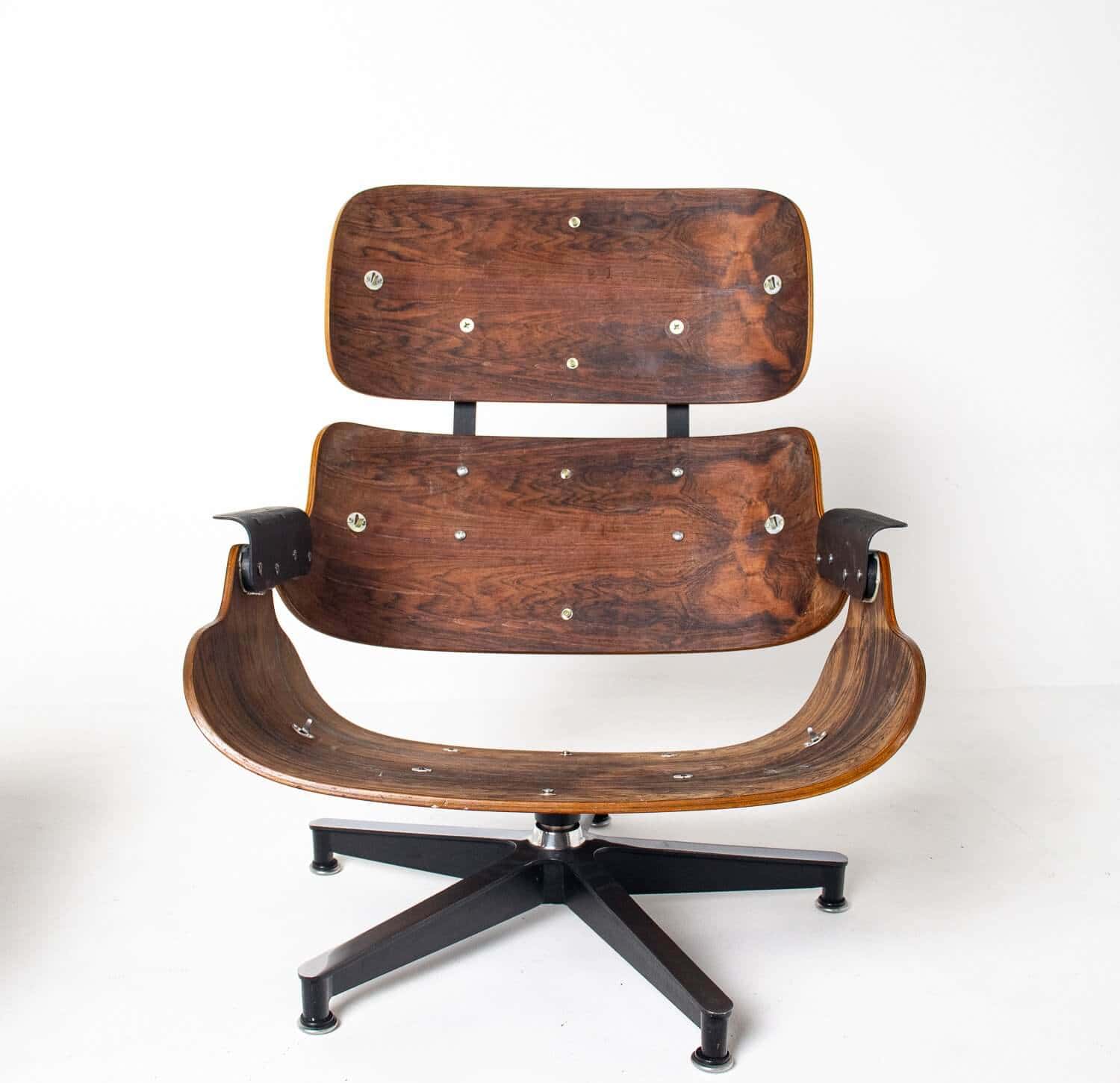 Eames Lounge Chair with our its leather cushions. Showing the 3 plywood shells it's made up of as well exposing the internal rosewood and vintage cushion hook system on all1st and 2nd generation chairs.
2 Posts - Two aluminum posts connect the middle and top shells together. Each post has 3 screws, 1 for the top and 2 for the middle.
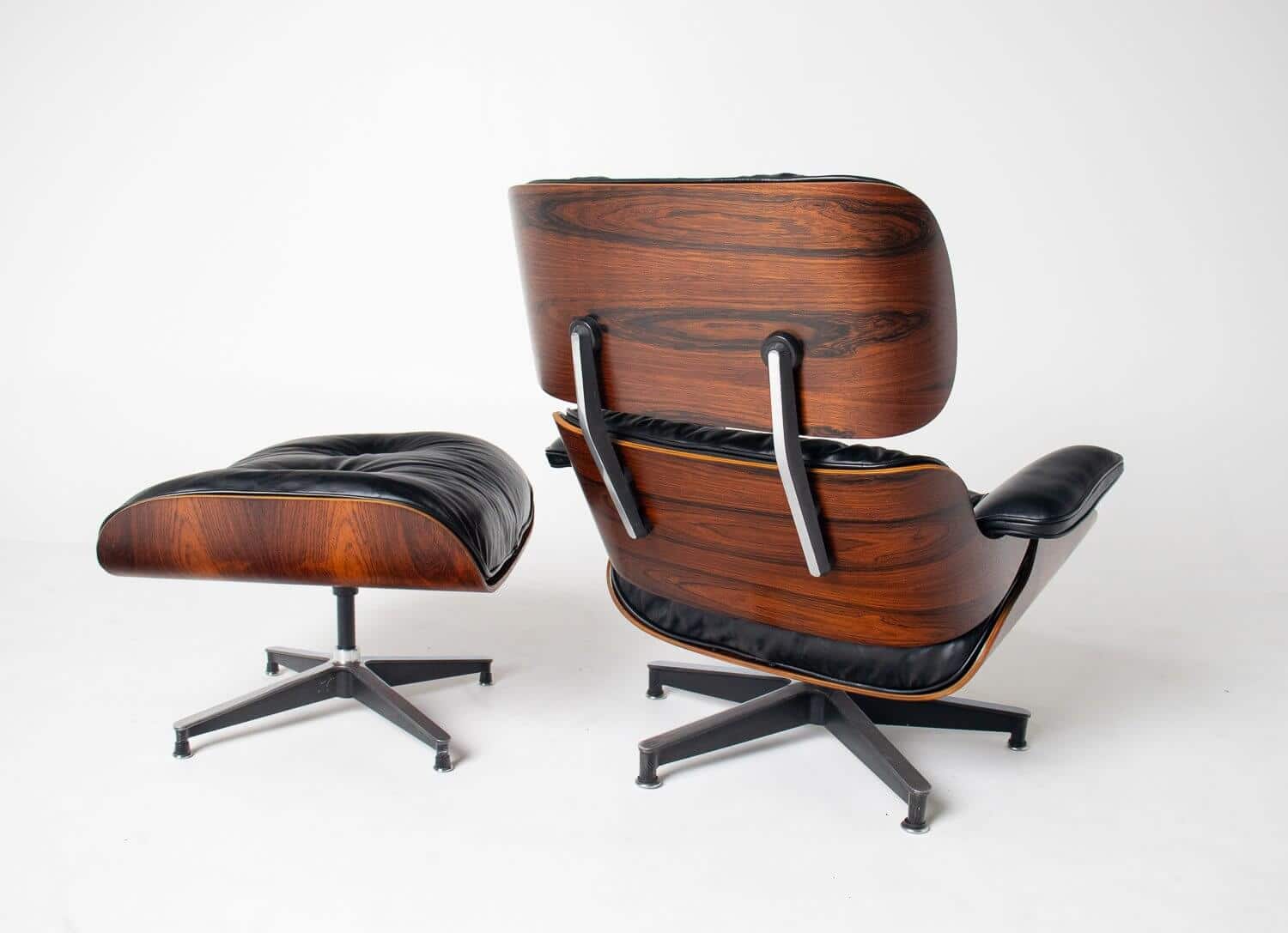
Rubber Cushions - The back posts will have thick rubber shock mounts between them and the wood, allowing for some flex. Chairs made from 1956 - 1969 have threaded rubber shock mounts. Post 1971 Herman Miller switched to hollow plastic mounts.
Armrests - the bottom and middle shells are held together at the armrests by shock mounts attached to a rigid black lacquered steel plate. The arms then attach to the black plate with screws.
 The entire weight of the person sitting in the chair is held up by the four shock mounts under the black lacquered arm plates seen here.
Armrest (screws) - This is the only place you will see an exposed screw. Screws should be black oxidized. Pre-1960 chairs have 3 screws (1st Gen) and post-1960 (2nd, 3rd Gen) chairs have 2 screws under the arms.
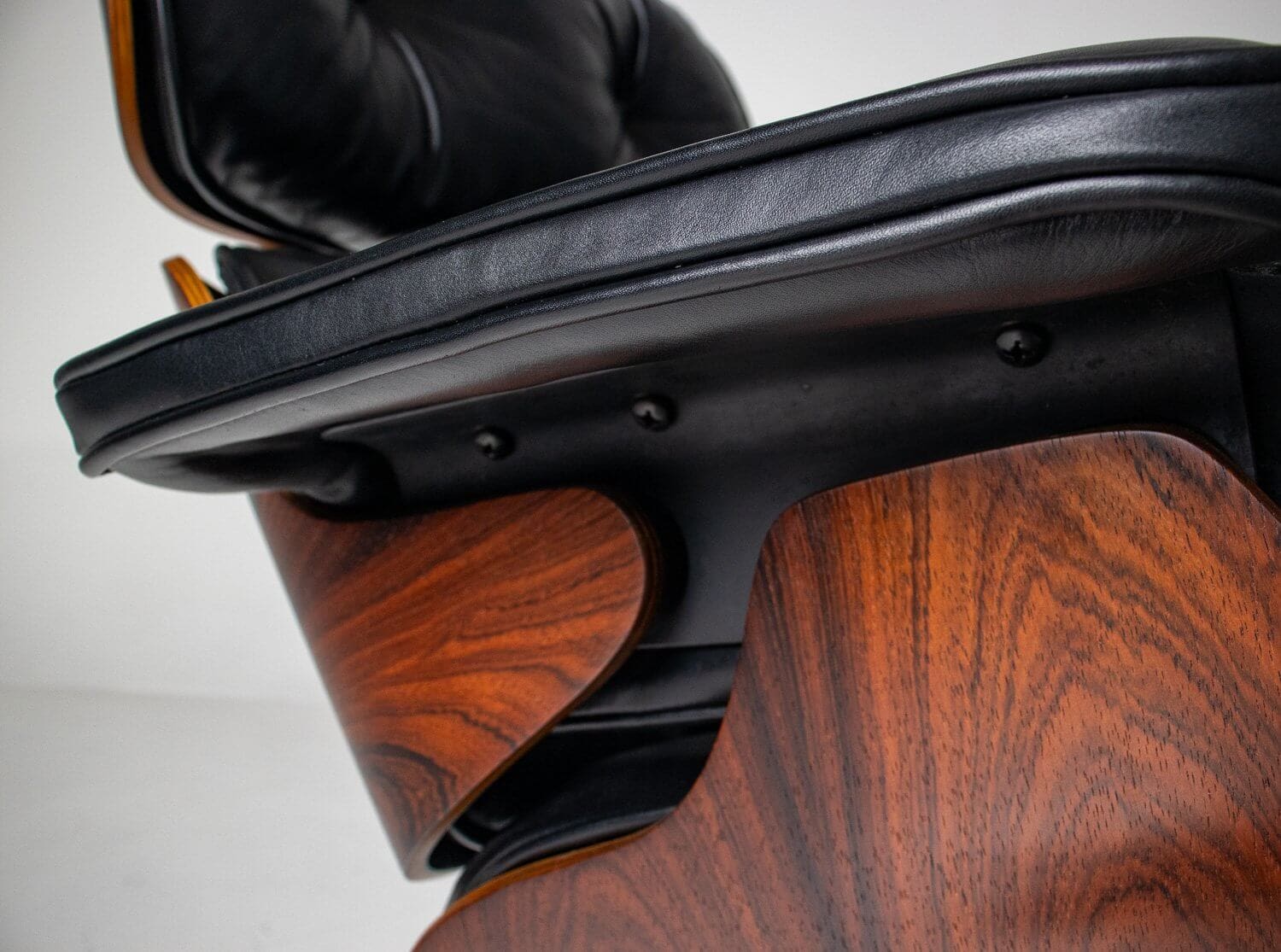 The only exposed Screws are under the arm rests. First Generation Eames lounge chairs have Three Screws hold the arms in place, while later Iterations of the chair had two screws. Herman Miller no doubt subtracting to cut manufacturing costs.
 The Flex — It Does Not Recline: - Authentic Eames Lounge Chairs do not recline. Instead, they flex. The four shock mounts beneath the arms allow the chair a natural give that adjusts with the sitter's movement. This is arguably the single most significant innovation to the design and manufacture of furniture during the era. Each shock mount has a metal plate encased in rubber with threads. Every Eames chair has a total of 4 shock mounts under the arms. The shock mounts are a patented design, allowing an Eames lounge chair to flex when you sit in it. The unique flex is one major hallmark that separates the real Eames Lounge chair from a copy. Knock-offs and chair in the style-of-Eames frequently have a tilt mechanism for reclining. ( Click to see the chair flex @ minute 1:17)
Charles Eames wrote for his US patent application filed on 28th July 1958. "In the development and designing of furniture one prevailing problem is the means for securing parts of the furniture together particularly when the parts are made of thin materials such as plywood or metal. This problem is particularly difficult when a certain amount of twisting or give between the parts is desired so as to provide resiliency. In general efforts to solve this problem have failed." There is however good news. "I have solved the problem by devising the shock structure of this invention."
The US Patent Office agreed, and on 31st January 1961 Charles Eames was granted US Patent Nr. 2,969,831 for a "Side Flexing Shock Mount."
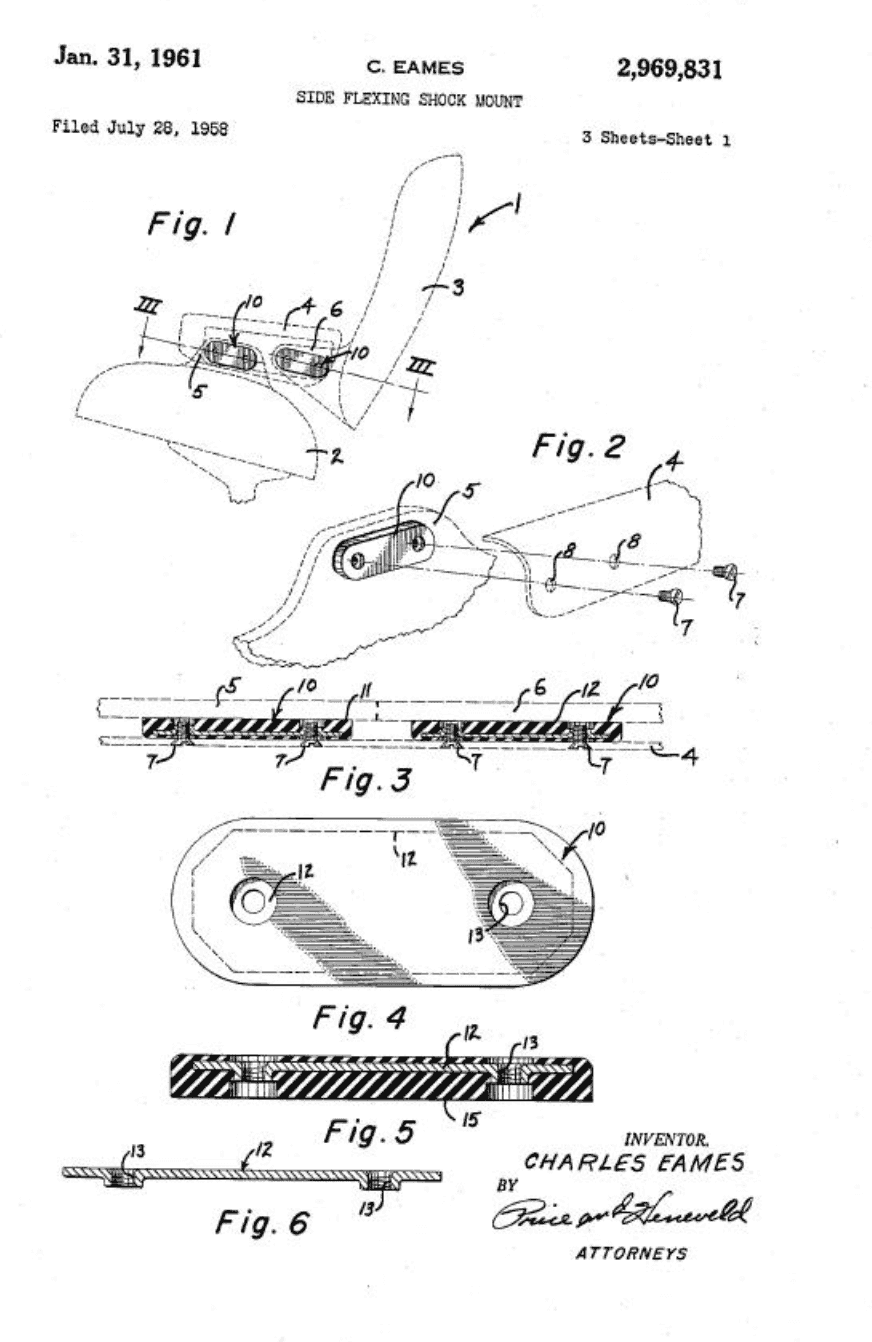
Note: After many years of use the shocks mount’s rubber can harden and loosen from the shell and fail completely. When this happens shock mounts can be replaced by a professional with experience, giving your chair new life. We recommend replacing all four shock mounts if one has failed. Often owners do poorly advised home repairs and drill thought the shells in hopes of fixing the chair. This repair never works. The best thing to do is take off the old shock mounts and put 4 new shock mounts on the chair. Hobbs Modern can provide this service. Click Here for Shock Mounts Repair Service
CANTILEVERED: An Eames lounge chair is actually a cantilevered design. The back of the chair is completely held up by the arm rests. The design element gives the back of the chair the its unique floating appearance.
Click Here to see Our Eames Lounge Chair Collection
THE WOOD
Molded Plywood: Vintage Eames Lounge Chairs are constructed from 5 layers of plywood. Modern versions use 7 layers. Critically, those layers should remain visibly distinct — they should never appear to "melt" into one another around the curves. Plywood that fuses along its curves is characteristic of Plycraft chairs and a reliable sign of a non-authentic piece.
Matching Veneer: The wood grain on each shell's veneer matches because all three shells are cut from a single log. In the factory, each shell is numbered to ensure it stays paired with its mates during assembly. On vintage Eames Lounge chairs, this number is impressed directly into the inside of the shell. Post-1971, Herman Miller began writing shell numbers with a black permanent marker. On all Eames Lounge Chairs — vintage and current production alike — the interior and exterior of each shell carry the same veneer. A rosewood chair has rosewood inside and out; a walnut chair has walnut on both faces.
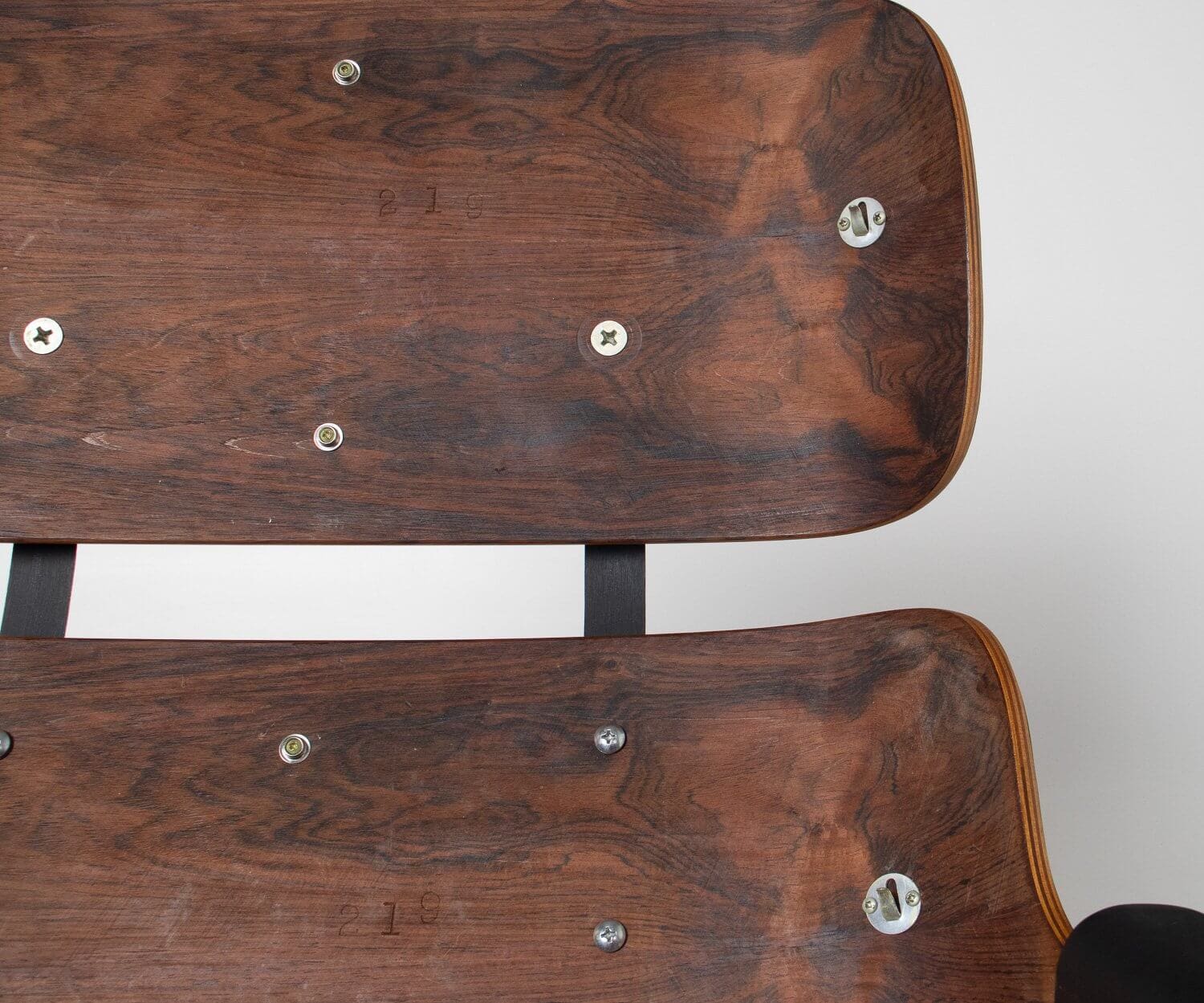 Matching Numbered Shells. Notice a faint "219" de-bossed on the inside of the chair. These numbers are how Herman Miller keeps track of the matching veneer shells during production. Early 1st Gen Chairs often have only chalk or pencil marks. Later Herman Miller de-bossed the numbers in shells during 1957-1969. Later they started using black permanent markers to write the numbers.
 Veneer Types: Vintage Eames Lounge Chairs feature old-growth Brazilian Rosewood — the most prized variant because this species can no longer be legally harvested, making vintage examples irreplaceable. Modern chairs are available in Cherry, Walnut, and Santos Palisander (a farm-raised Bolivian rosewood). Rosewood was the sole original veneer option until it was discontinued in 1991 due to sustainability concerns. Its color ranges from deep red-brown to medium brown and occasionally a lighter, almost blond tone. The grain features characteristic dark lines and varies from straight to a smoky, layered appearance. When sanded, rosewood has a distinctively sweet, floral scent — the origin of its name.
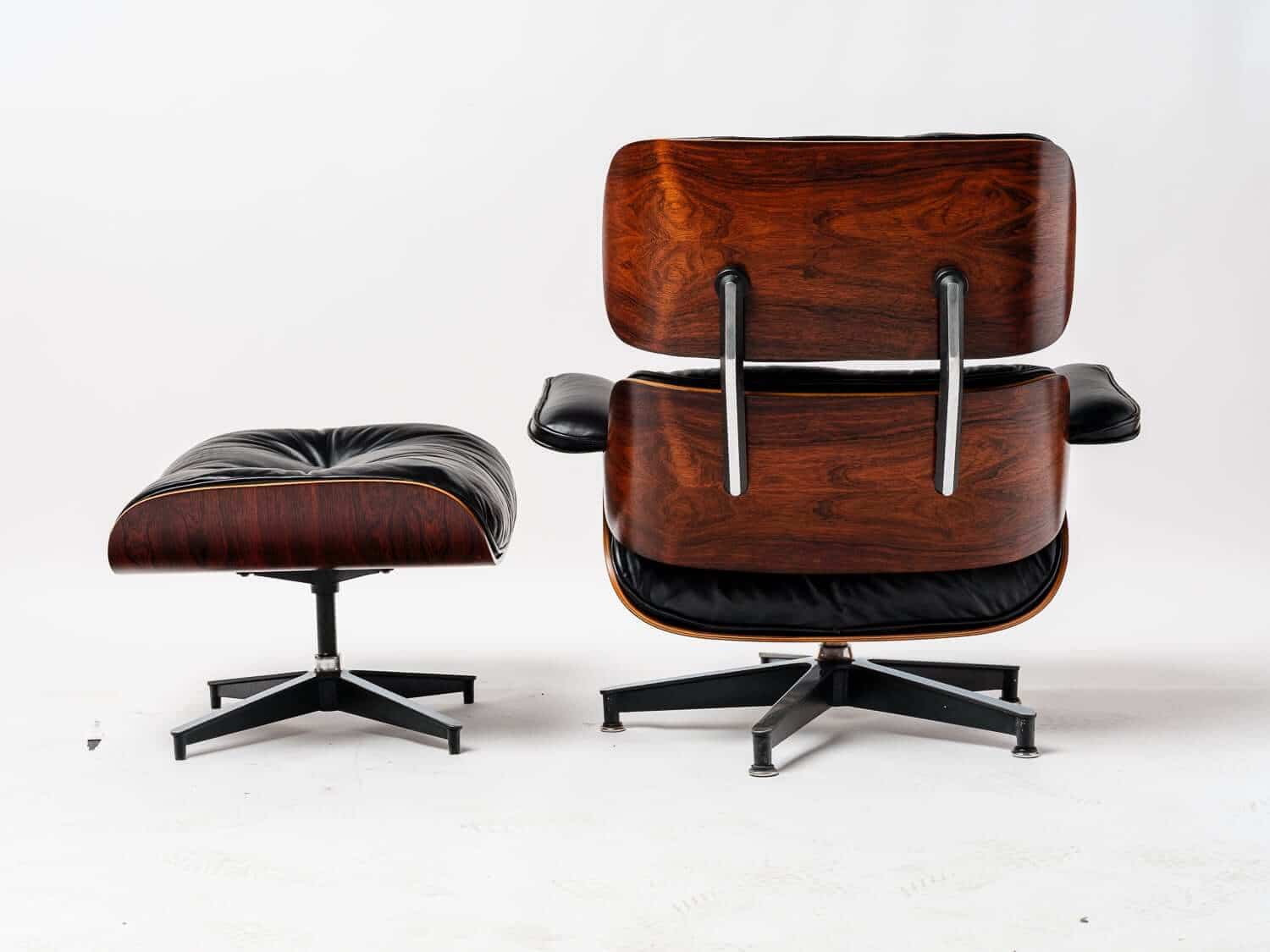 Beautiful Rosewood shells on a Vintage Eames Lounge Chair
 Smooth, Visible Edges: All edges should be smooth and gently rounded. The plywood layers should be clearly legible at every edge and curve — never blurred or fused together.
THE CUSHIONS
Interchangeable Seat and Ottoman CushionsThe bottom cushion is the same size as the seat cushion and is fully interchangeable with the ottoman cushion.
Six Inches of Padding: Vintage chairs have 6" of down feathers. Newer chairs have 6" of urethane foam.
Almost Always Leather: Fabric examples exist but are rare. Most authentic chairs are upholstered in soft leather. Black leather with rosewood was always the Eames' intended expression of the design, though the chair was produced in a range of colors — brown, white, red, green, and others. The original premium leather was sourced from Scotland, where farmers did not use barbed wire, resulting in unmarked hides of exceptional quality.
Two Leather Buttons Per Cushion: Each cushion has two leather buttons centered in the face, creating a subtle gather with just the right amount of wrinkle. The leather should never appear stretched tight.
Zippers: The leather attaches to hard plastic backing shells via zipper. On 1st and 2nd generation chairs, the cushion backing is a laminated cardboard-type material that is no longer manufactured.
Cushion Clips: Two clip styles were used across the production history:
- 1st and 2nd Generation (approx. 1956–1969): Round, circular clips.
Round Cushion Clips found on a 2nd Generation Eames Lounge Chair
- 3rd Generation through current production (approx. 1970s–present): Rectangular clips.
Rectangular Cushion Clips found on 3rd Generation and modern chairs.
Armrests: The armrests curve gently inward toward the seat and are not flat. The edges are finished with welting or piping — never a solid, unbroken piece of leather.
THE LABEL
Round Metal Disc - between 1956-1969 the Herman Miller logo was in the center and the legend "Designed by Charles Eames - Herman Miller Zeeland, Mich” around it. The label color was white and or black. This period marks a significant part of the Herman Miller label history. * Some early 1st Gen. chairs had the Rectagular Herman Miller logo.
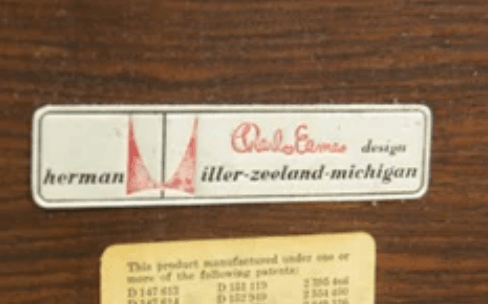
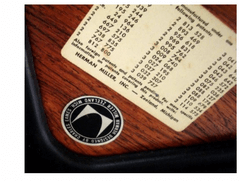
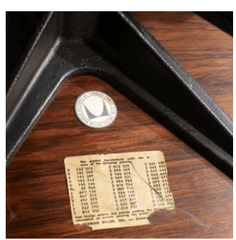
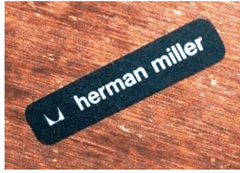
Black Label - between 1970-90 a black rectangular label with rounded corners that says "herman miller" (in lowercase) was used.
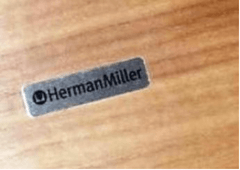
Silver Label - after 1990 the black label was switched to a silver one with black text. The text says "Herman Miller” in capital letters.
Paper Label - Eames Lounge Chairs are signed with a paper label, though it is easy for these labels to fall off especially due to heat, humidity, and age. The paper label will list all of the chairs patents, contributing to the Herman Miller label history.
Bottom Shell - look under the chair where the base connects to the shell, you should see a label here.
Under the Cushion - if you can not find a label on the bottom of the chair, slide off the cushions, there may be additional ones attached to the cushions. Or inside the seat or back rest cushions.
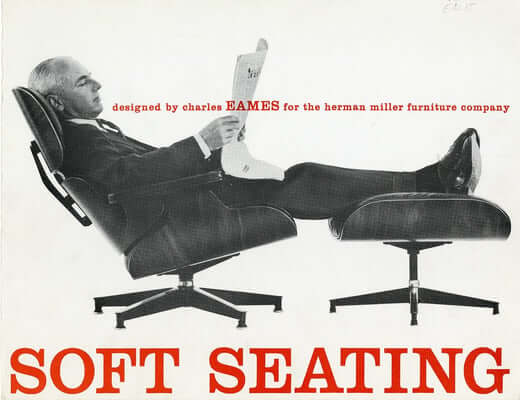
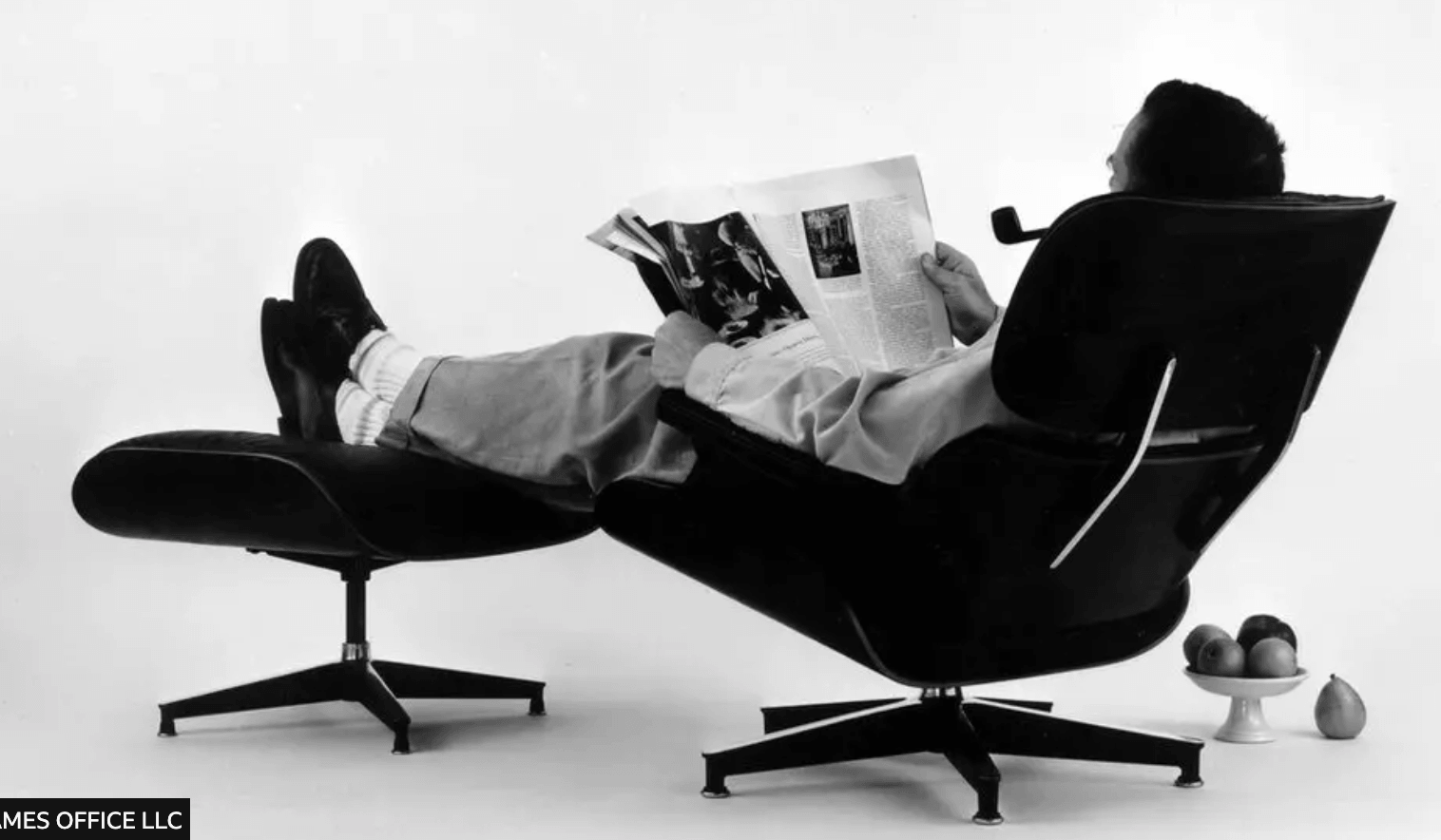 Old advertisement for Eames Lounge Chair Copyright Eames Office LLC
CHANGES OVER THE YEARS
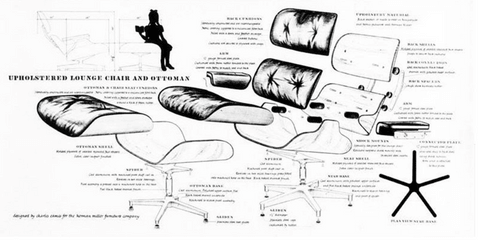
While the basic chair has stayed relatively the same throughout the years there have been some small changes. These small details can help determine its age.
1st Generation 1956-57
Not all experts agree. We would argue there are 3 versions of the 1st Generation Eames chairs production dating from 1956-1957. If you own one of these chairs, you are part of the lucky few. Enjoy and cherish your chair. You own a piece of design history.
Three types of 1st Generation Eames Chairs
1st Gen. Earliest Chair/Prototype Production
Dating From: 1956
- Spinning Ottoman- Stuff of legends (maybe 100 in existence no one really knows)
- Three Screws under the arm rests
- Boot Glides on the ottoman
- Calk or pencil marks with initials and numbered shells
- Rare Rectangle Eames Herman Miller Label or Round Label
- 100% down filled cushions
- Silver circular cushion clips
- 100% down filled cushions
- Threaded cushions snap screws.
- Brazilian rosewood veneer
- Dooms of Silence
- Originally done in Gunstock Oil finish
- Bronze swivel bushing
- "Wings" on the backrest are noticeably narrow when compared to the 2nd or 3rd Generations of chair.
1st Gen. Boot Glides Production
Dating From: 1956-57
- Three Screws under the arm rests
- Boot Glides on the ottoman
- Debossed Numbers on each shell
- White or Black Round Herman Miller Label
- 100% down filled cushions
- Silver circular cushion clips
- Threaded cushions snap screws.
- Brazilian rosewood veneer
- Dooms of Silence
- Originally done in Gunstock Oil finish
- Bronze swivel bushing
- "Wings" on the backrest are noticeably narrow when compared to the 2nd or 3rd Generations of chair.
1st Gen. Three Screws under the arm rests
- Three Screws under the arm rests
- Domes of Silence feet on the ottoman
- Debossed Numbers on each shell
- White or Black Round Herman Miller Label
- 100% down filled cushions
- Silver circular cushion clips
- Threaded cushions snap screws.
- Brazilian rosewood veneer
- Dooms of Silence
- Originally done in Gunstock Oil finish
- Bronze swivel bushing
- "Wings" on the backrest are noticeably narrow when compared to the 2nd or 3rd Generations of chair.
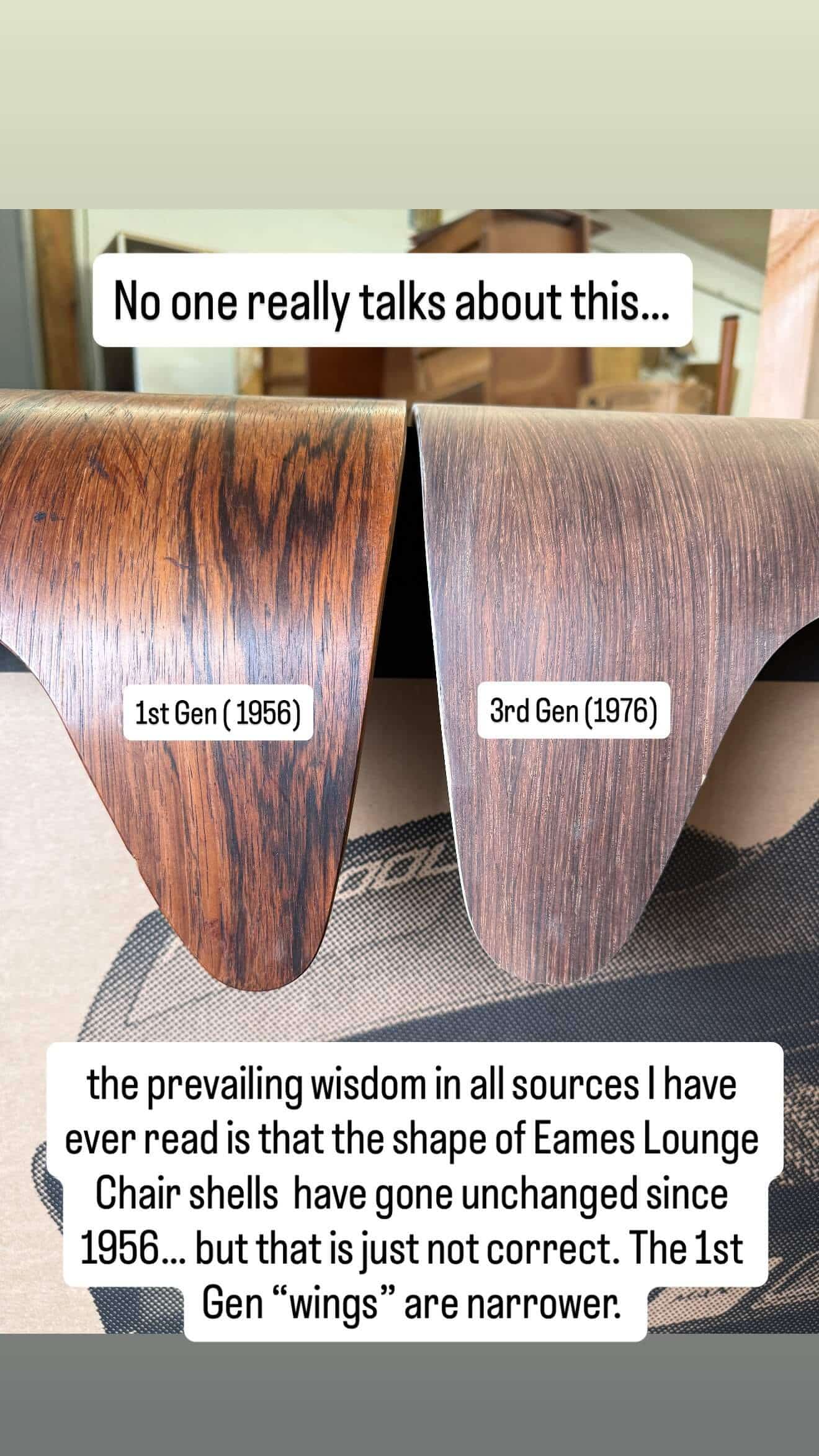 Comparison of two Eames Lounge Chair Backrests. You can see the shape of the "wings" have changed overtime.
Comparison of two Eames Lounge Chair Backrests. You can see the shape of the "wings" have changed overtime.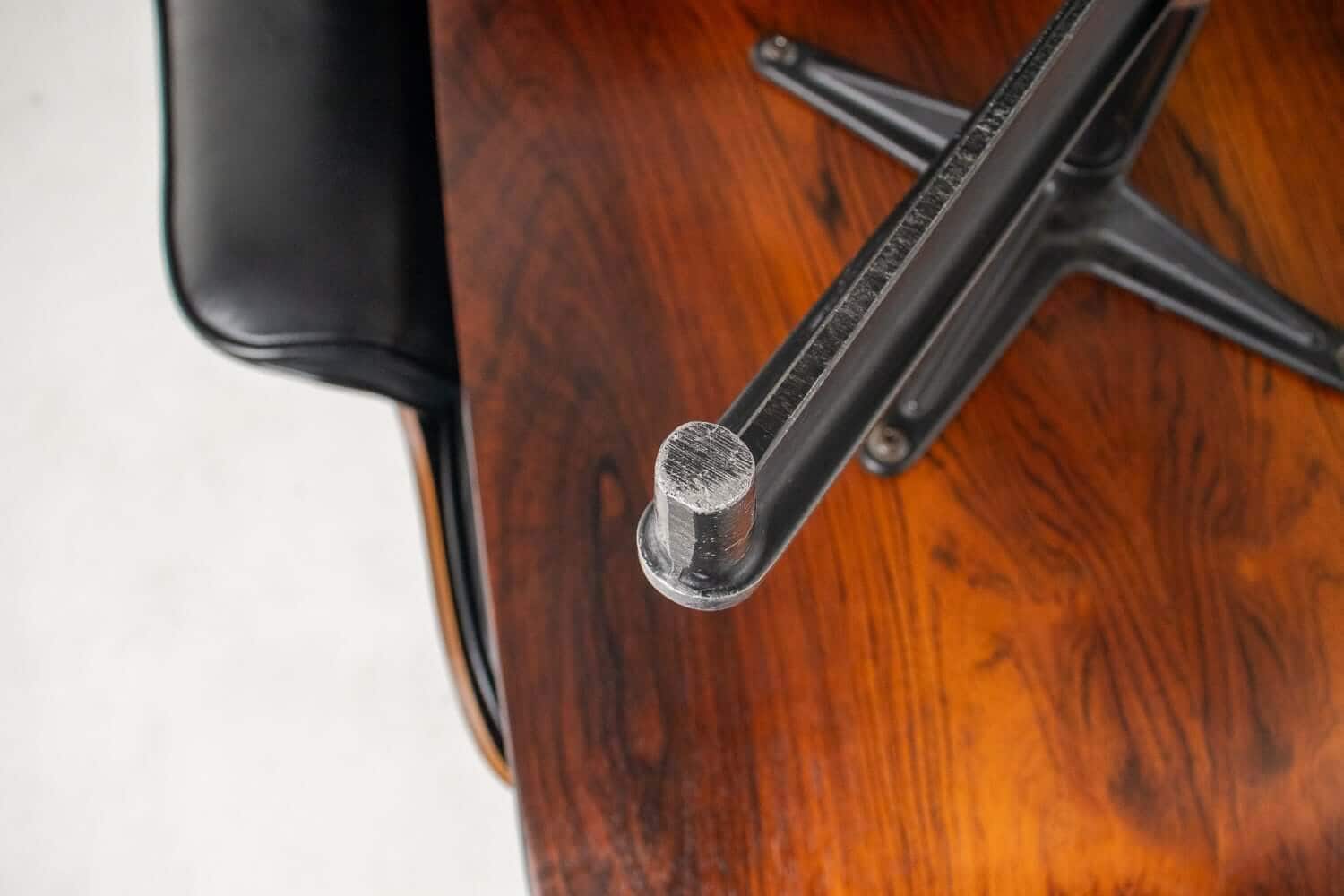 1st Generation Ottoman without its boot glides on. Base shows "no holes" indicating it never had domes of silence installed.
 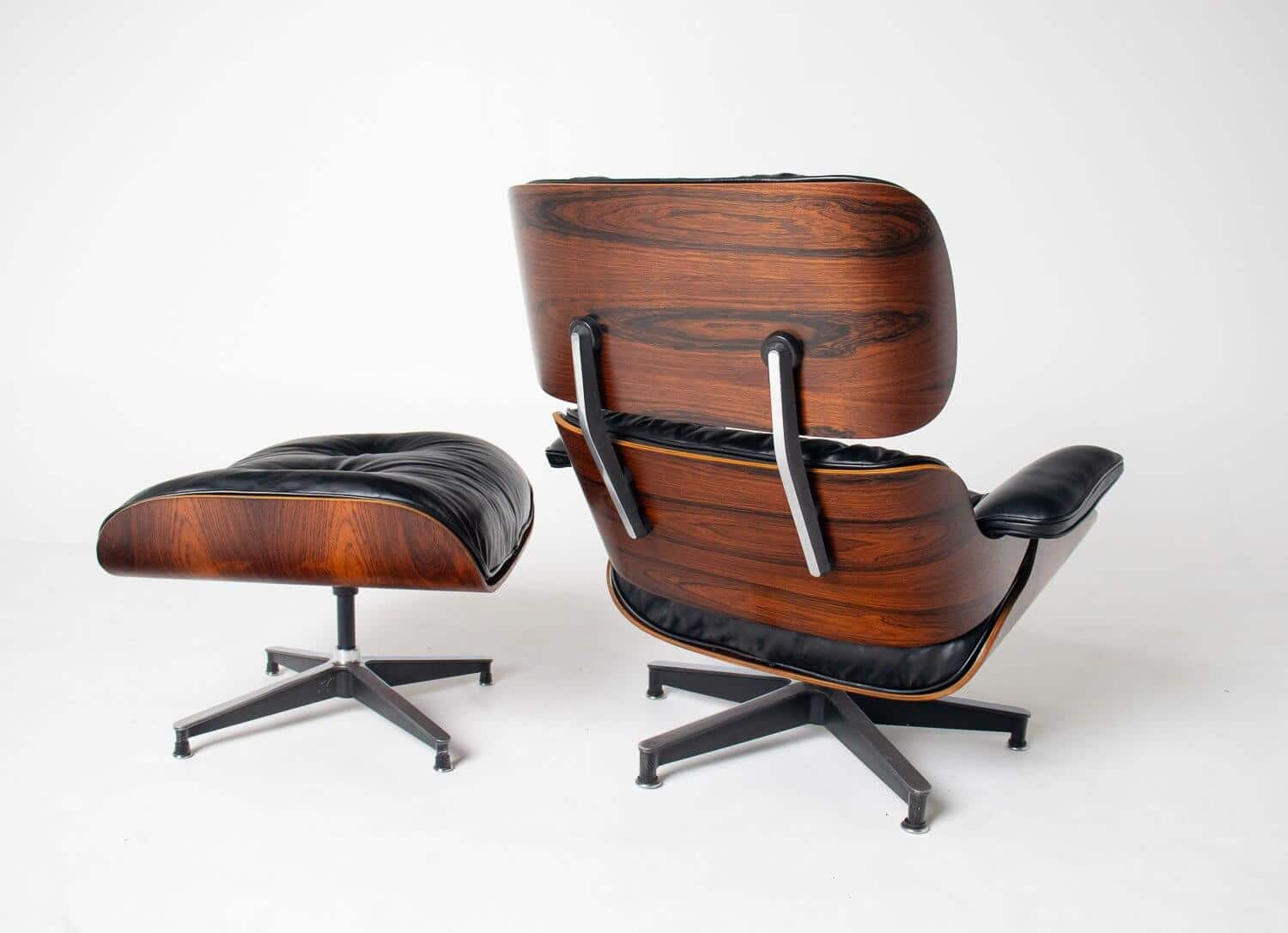 1st Generation Eames Lounge Chair with boot glide ottoman
2nd Generation Eames Lounge Chair 1960 - 1969
An amazing vintage chair and a rare find. Count yourself lucky to have an icon.
- 5 layers of plywood
- Silver circular cushion clips
- Down cushions + foam materials
- Adjustable glides to chair and ottoman base
- Two screws to armrests
- Black or White Round Herman Miller label
- Brazilian rosewood veneer
- Oil finish
- Bronze swivel bushing
3rd Eames Lounge Chair 1970 - 1991
These chairs are still considered vintage, and are still made of rosewood but no longer have down feather filled cushions.
- 5 layers of plywood
- Long black rectangular shaped cushion clips (Oct '71)
- Foam and fiberfill cushions
- Adjustable glides to chair and ottoman base
- Two screws to armrests
- Long rectangular Black Herman Miller label
- Brazilian rosewood veneer
- Lacquer finish since 1980
- Plastic swivel Bushing
4th Generation Eames Lounge Chair 1991 - TODAY
You have great taste and have bought an iconic piece of furniture.
- 7 layers of plywood
- Long black rectangular shaped cushion clips
- Foam and fiberfill cushions
- Adjustable glides to chair and ottoman base no longer read “Domes of Silence”
- Two screws to armrests
- Long silver Herman Miller label as well as a barcode and other serial numbers
- Walnut, Cherry, Oak, or Santos Palisander veneer (farm raised Bolivian Rosewood) starting in 2006
- Lacquer finish
- Plastic swivel bushing.
SIGNS OF A FAKE
Oversized - most knock-offs and reproductions get the proportions all wrong and make the chairs too large, especially the arms.
Recliner - if your chair reclines, it is not an Eames Lounge Chair. Period. Knowing how to tell if an Eames chair is real involves checking for this feature.
Flat Feet - often the base will be made with square, flat legs and feet/glides that do not adjust.
Tip Toes - other times the legs will be at such a steep incline that the chair looks like it is standing on its tip toes.
42-45" Tall - replicas often bring the headrest up another 10-13 inches higher than an Eames Lounge Chair.
Visible Screws - it is a lot of work to hide the screws and keep the chair structurally sound.
Quick Picture Guide to Spotting Fakes
A quick scroll through Facebook Marketplace and your bound to find many "Eames Lounge Chairs" for sale. We have made a quick guide to spot the obvious fakes to save your time and money.
1. Selig/Plycraft Vintage Fake:
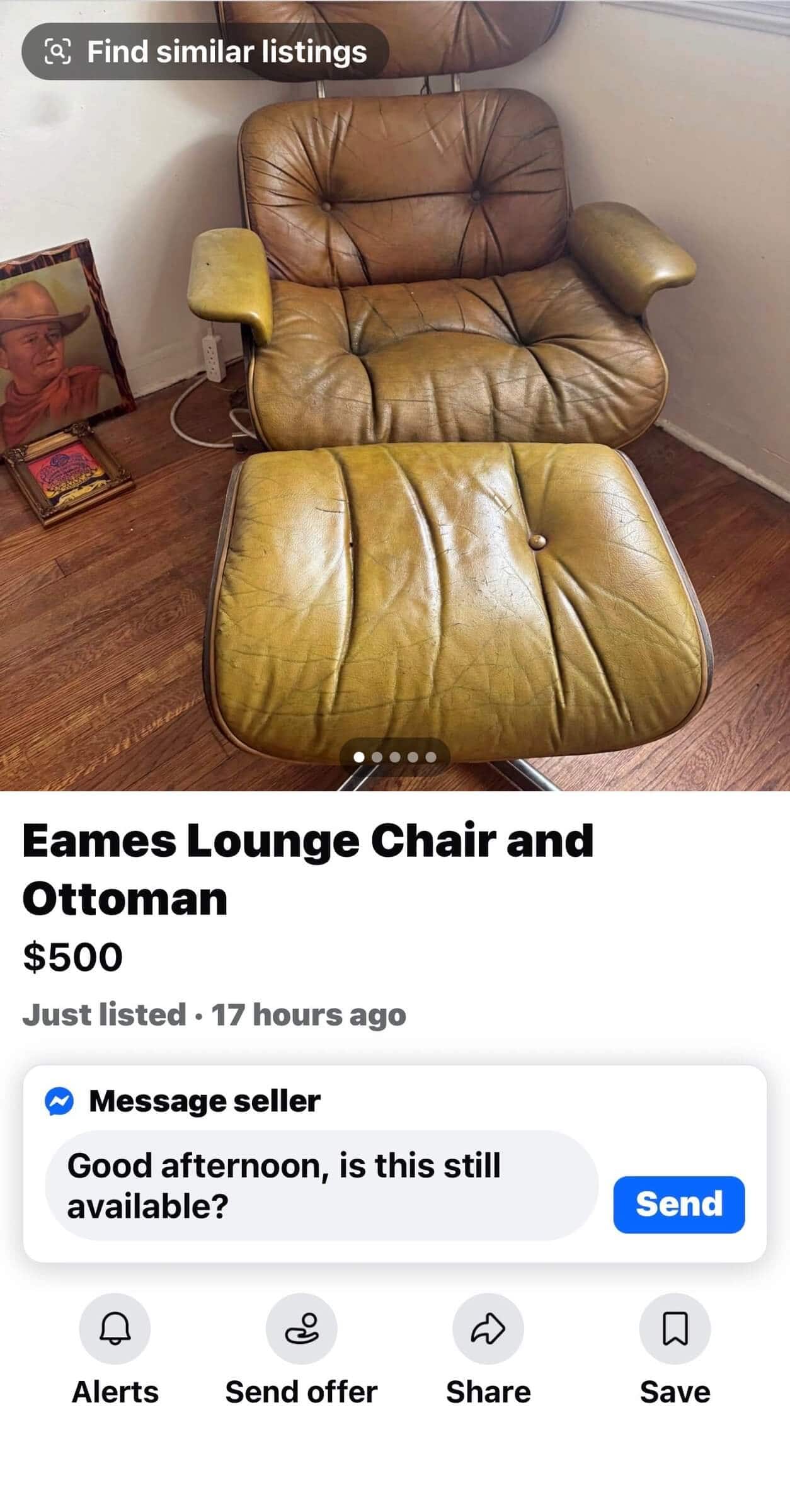
So many things are not correct about the chair. 1.The base is not correct. 2. The arms are also not correct for an authentic Eames Lounge chair the lack the correct shape and welt on the leather. 3. Backrest is to large and tall.
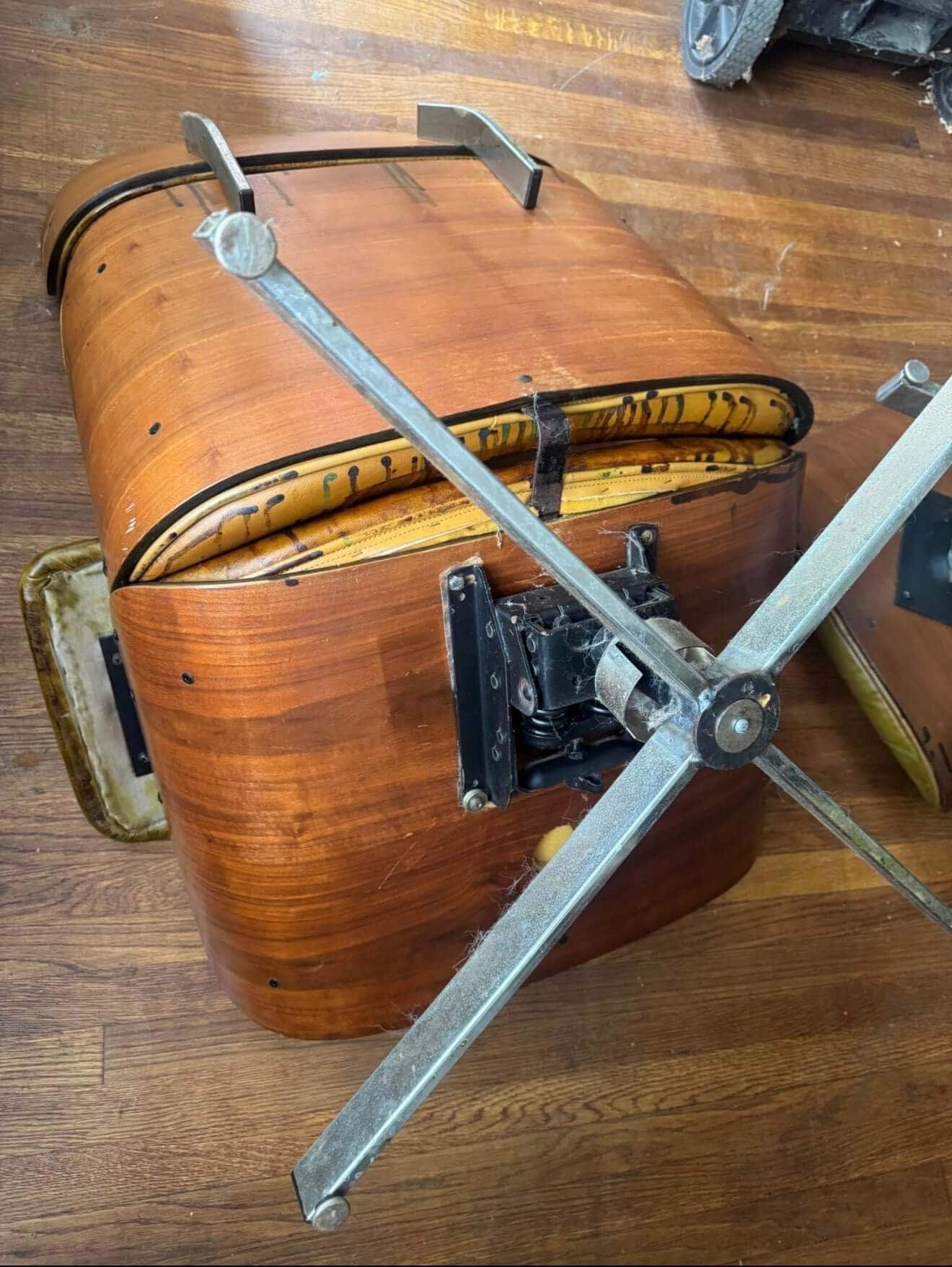
These are more photos from the same seller. You can see the base of the chair is not correct. It has a tilt mechanism on the base, as well as exposed screws on the shells, shells are made of walnut plywood (not correct for vintage Eames Lounge chairs), in addition the hole in the shell for air to escape when sitting is also not correct.
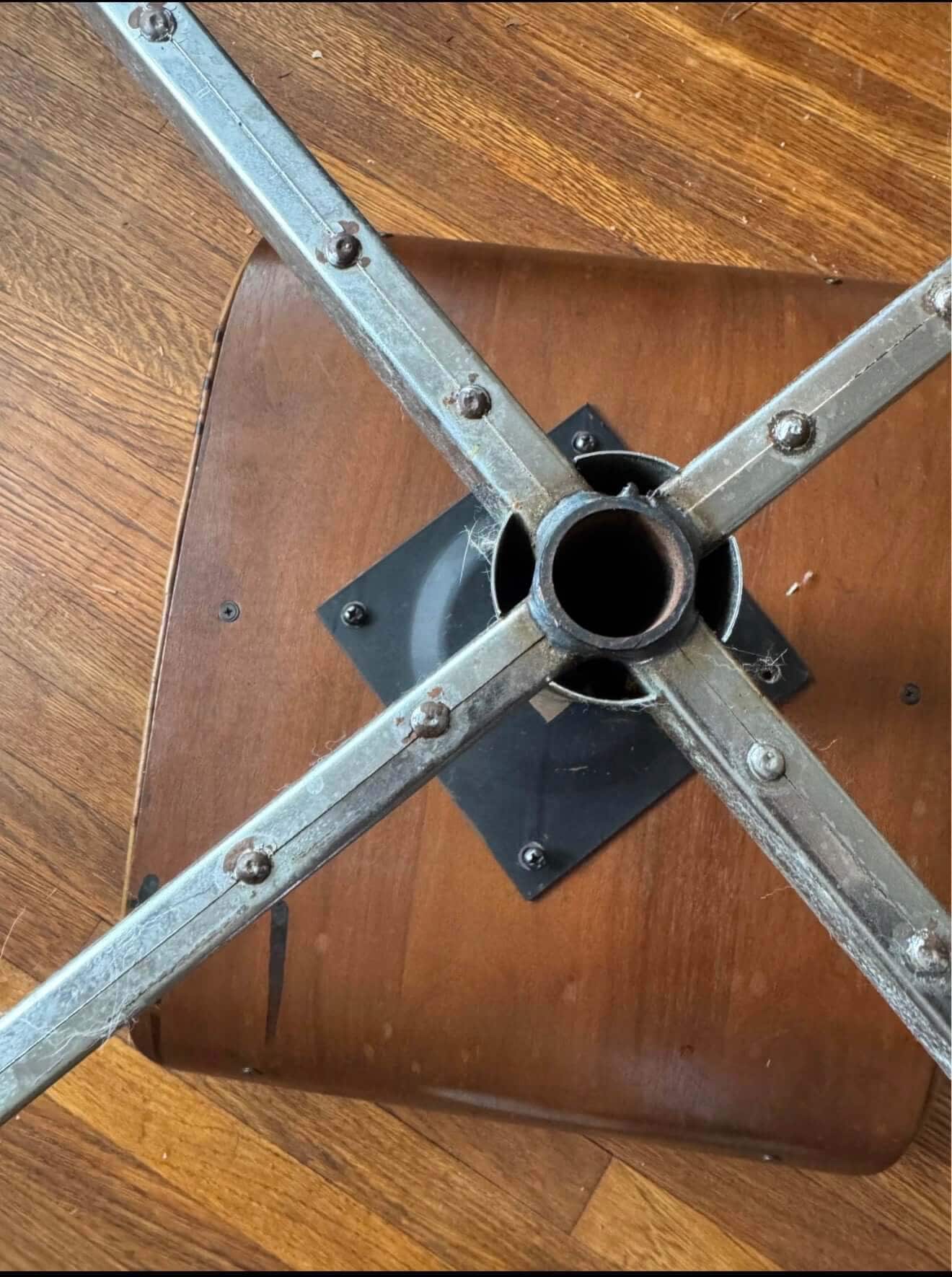
The ottoman picture further confirms that this chair is not an authentic Eames Lounge Chair. The quality of the base is not at the same level as a Herman Miller base.
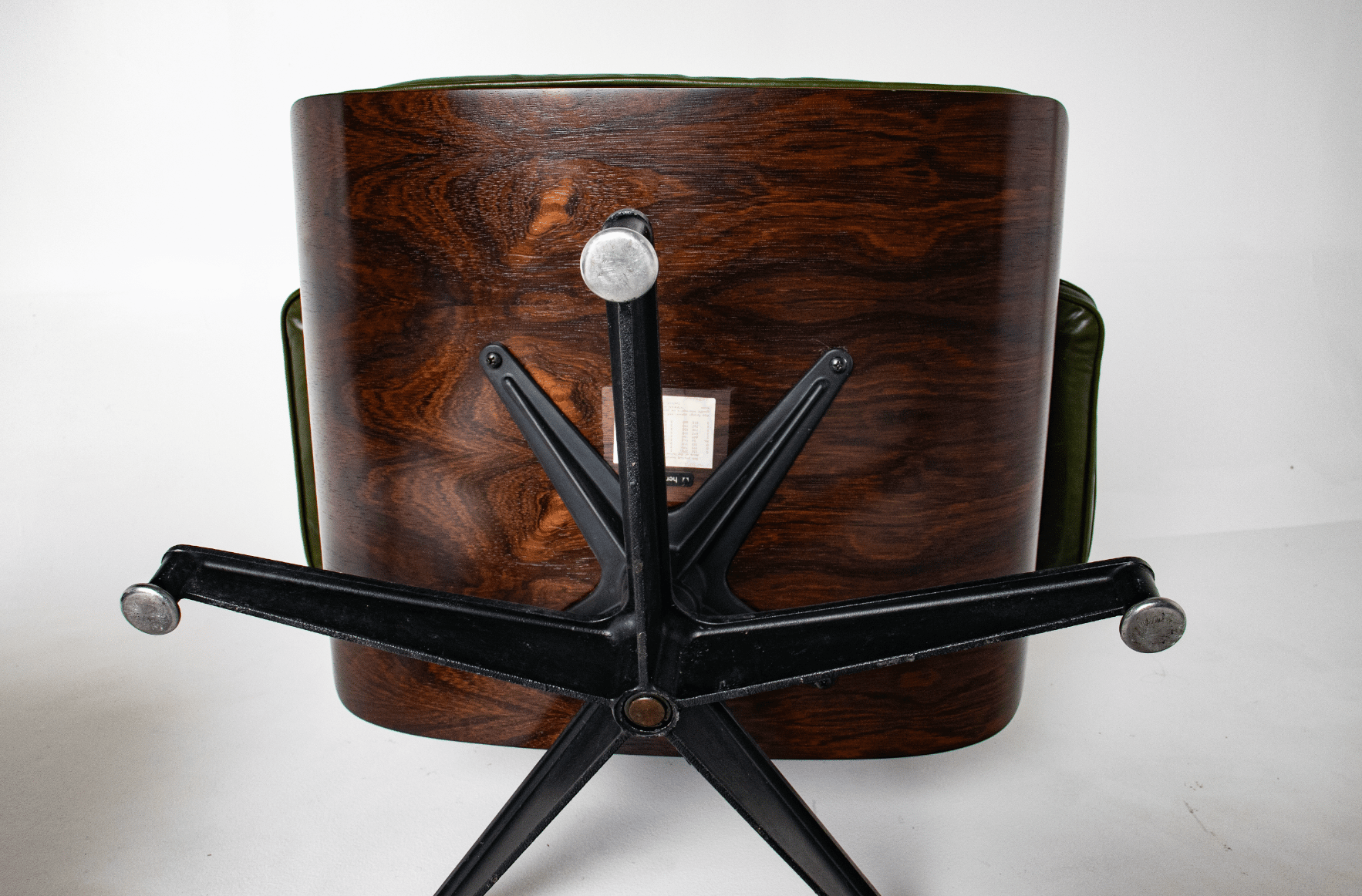
For comparison Here is authentic Eames Lounge Chair base and underside. No screw holes, No holes for air to escape when sitting down, black lacquered base with Domes of Silence leveling feet.
2. Fake Vintage most likely a Canadian Chair
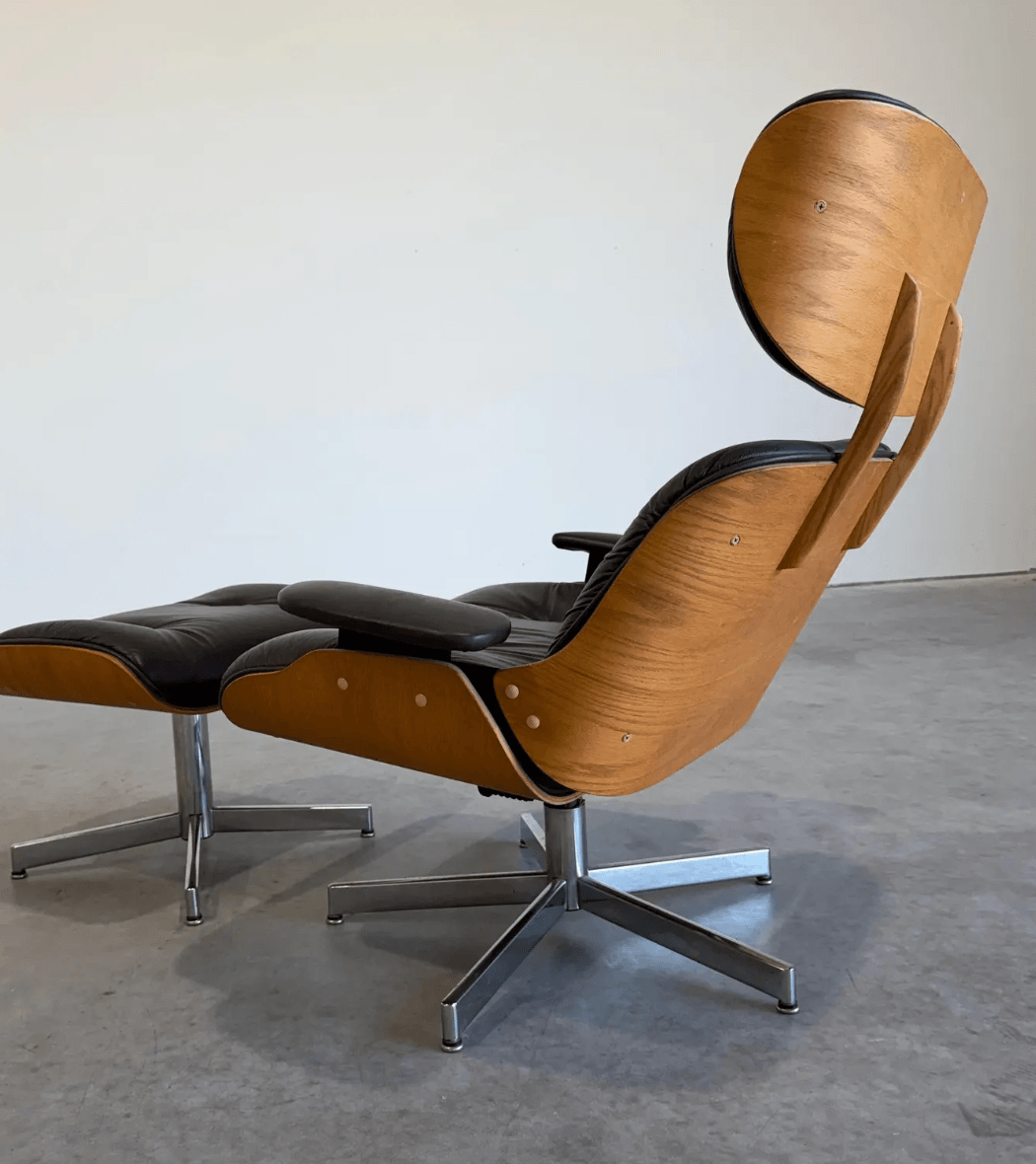 Most likely a Canadian Chair in the Style of Eames. Wood Pillers is a dead give away as are the arm rests not the same shape as the Eames Lounge Chair.
 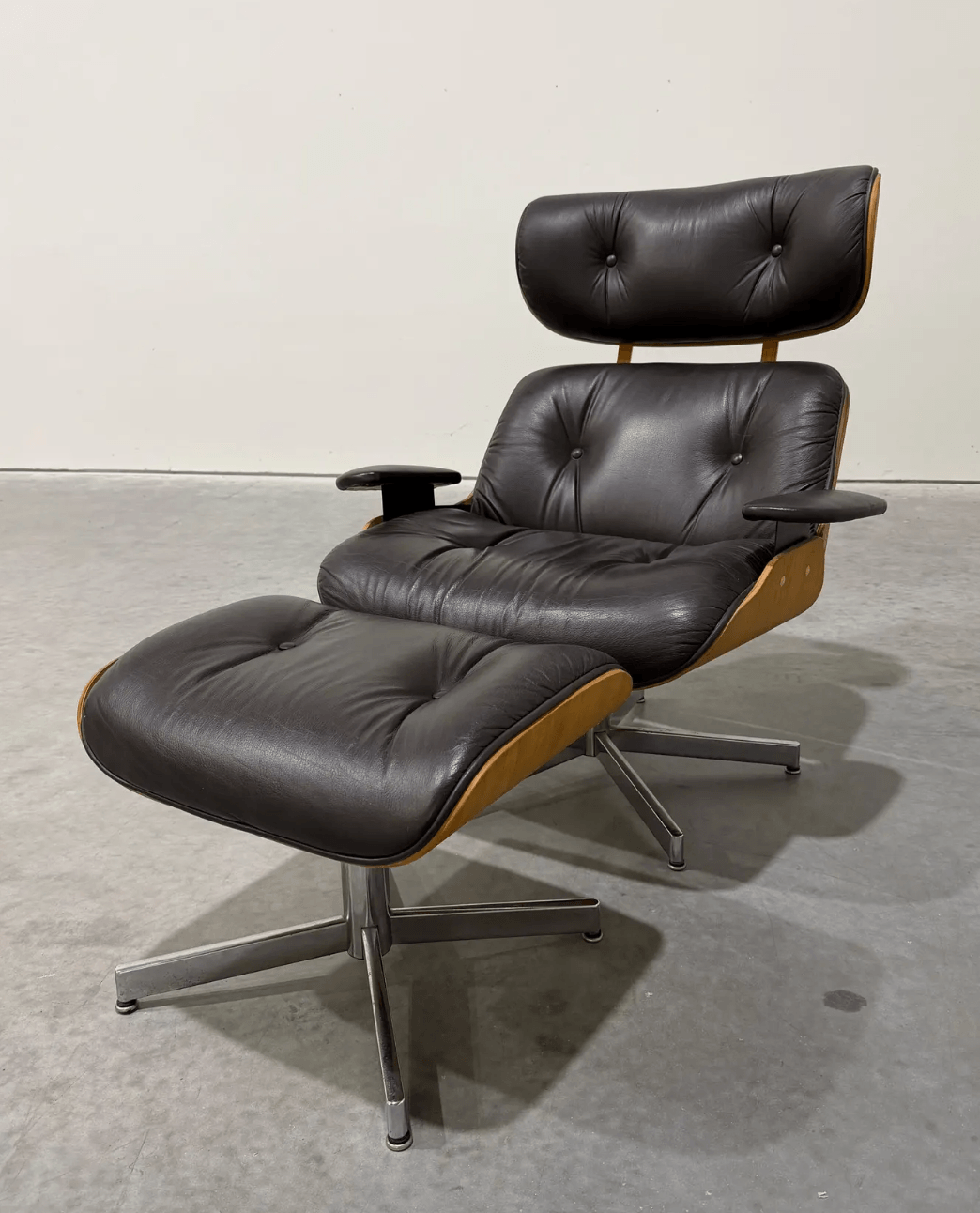 From the front view you can see the base is not correct. The chair sits to upright which is a giveaway that it has a reclining mechanism under it. The bases are incorrect too lack the correct shape and black enamel.
 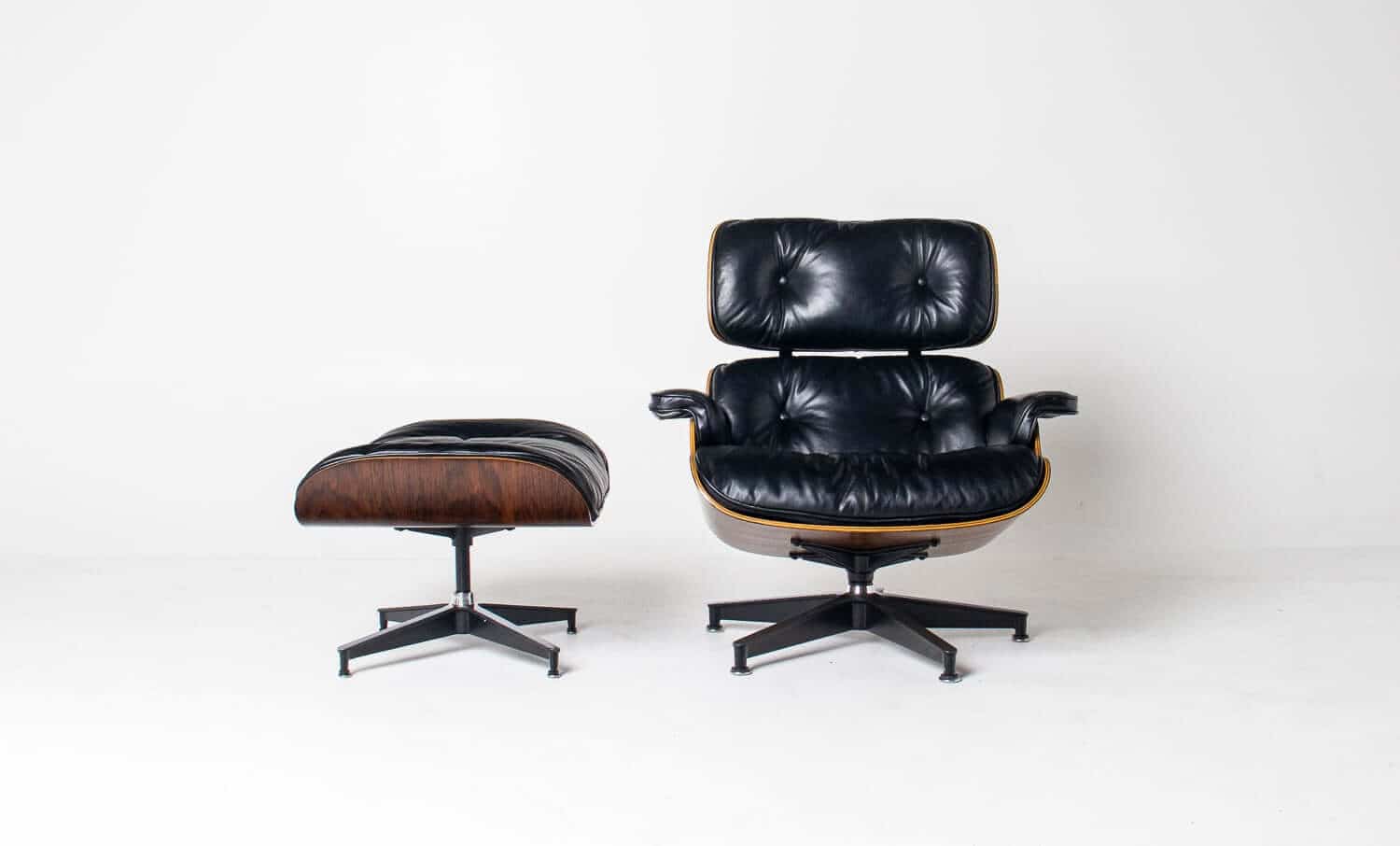 Pictured an Authentic Eames chair for comparison
3. Most likely a Chinese made copy of an Eames Lounge Chair
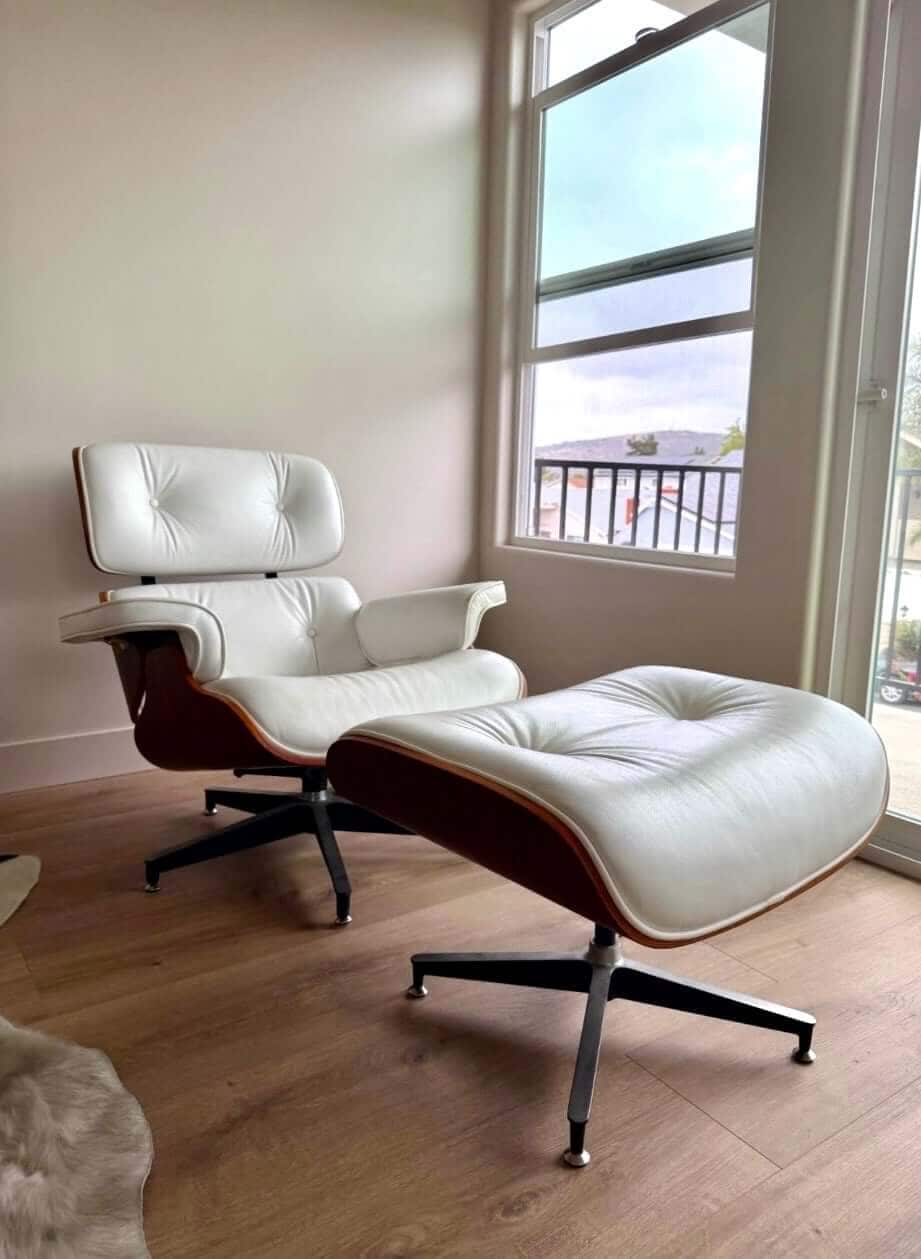 This one is maybe not be as obvious to some. If you look closely the arms look to large and the curve of the ottoman and shells looks off. The feet don't have the correct rubber and metal feet.
 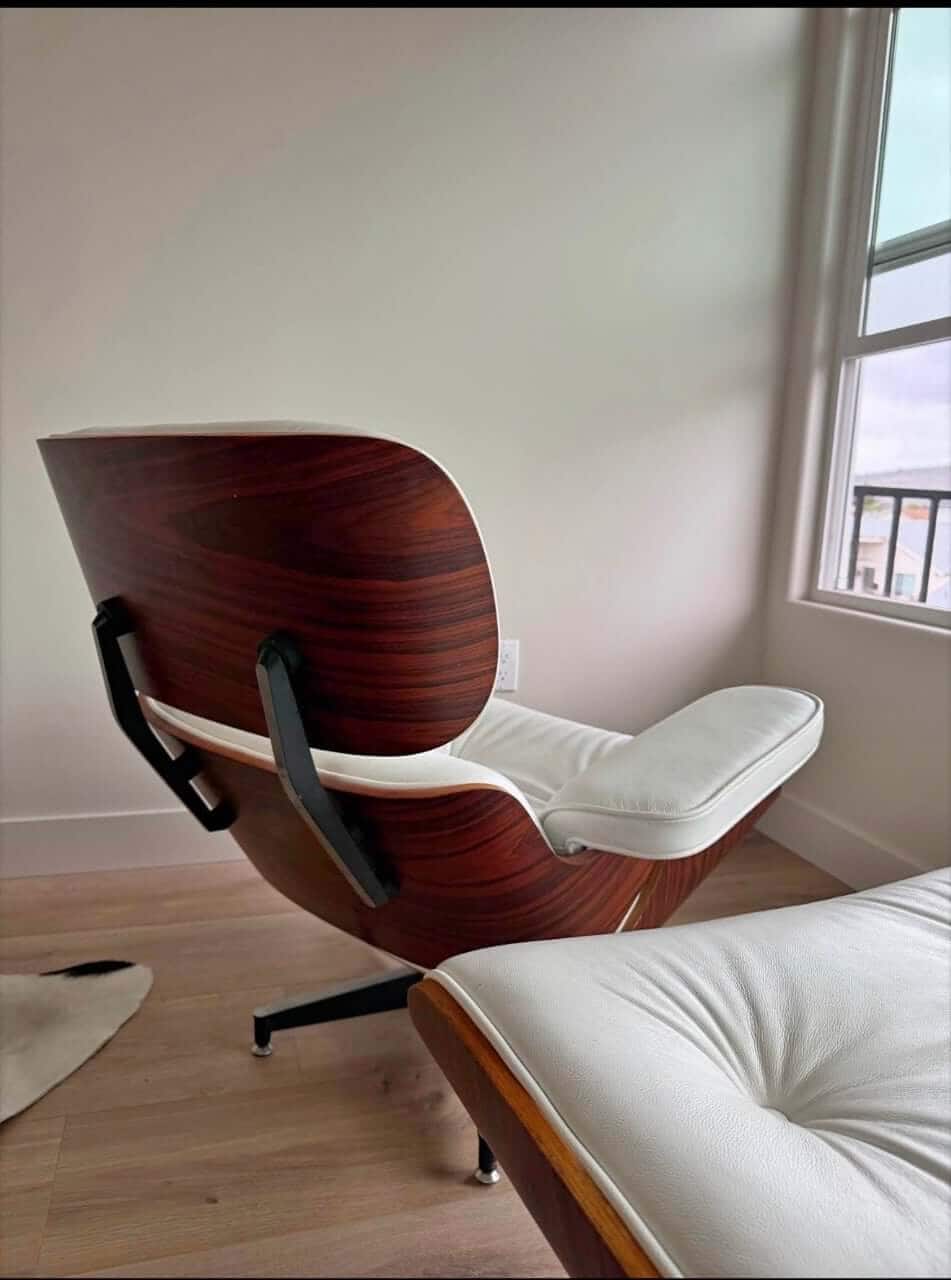 From this Angle we can see the arms is just to large and looks chunky. The arm lacks the refinement of the original eames chair. Here we can also see that the plywood looks thick compared to the fine shape of the authentic eames chair.
 Note: While Eames Lounge Chairs had some variations over the years the chair has more or less stayed the same. It is after all a mass produced and industrial chair. In other words, if your looking at a chair and it does not look identical in shape and from to an authentic Eames Lounge Chair its a Fake.
**It should be noted that the Eames Lounge Chair is manufactured by Herman Miller for the US market, Vitra produces for the European and Middle Eastern market. The Vitra chair does have some differences to the Herman Miller chair. The base of the chair has rounded feet and some other differences. This is not meant to be a definitive guide to the authenticate a Vitra model of the Eames Lounge chair.
Additional Links & Credits:
Click to see Hobbs Modern Collection of Vintage Eames Chairs
My Eames Lounge Chair and Ottoman
Bedtime Stories of the First Eames Lounge Chair in Europe
Interview of Floor manager where the Eames 670 Lounge Chair is Manufactured (Skip to minute 1:17 to see how shock mounts flex)
Herman Miller Video showing production of Eames Lounge Chairs
The Making and Design of the Eames Lounge Chair and Ottoman